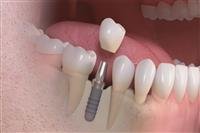
Many are looking for options to replace lost teeth, especially through dental implants or dentures, what is dental implants and how is this implant? There are several options to compensate for a tooth, group, or all missing teeth, including: - Plastic dentures: It is a moving plastic piece that replaces a tooth or a small group of teeth.
Lost temporarily, it is cheap, easy to break, and is often used by the elderly.
Partially molded dentures: it is also mobile, but it is made of a special metal or alloy, and holds fixed arms and spurs, and is designed to remain in service for a long time.
Complete dentures: It is the traditional solution for people who have lost all teeth in one or both jaws. The success of these mobile devices also depends on the shape and size of the remaining jawbone after tooth extraction, and on the ability of the person to adapt and get used to using and carrying these sets in the mouth, as many people do not adapt to it. Or do not bear it.
Dental implants: which are used to secure a base or root to support compensation that may be for one tooth, a group of teeth, or all of the teeth. After years of study, research and clinical experimentation, we can now add this option to compensate more reliably, effectively and successfully than the previous options.
Teeth supported by implants or dental implants, can be fixed with cement like traditional bridges or with special screws, and these teeth can be mobile crews supported on two or more implants to provide stability and stability in the mouth.
Dental implants
A person may be exposed to the loss of any or all of his teeth, and when following the traditional methods, the missing teeth are replaced by making fixed or mobile fixtures according to the condition required, but now with the tremendous development in the field of dentistry it has become possible to replace the missing teeth, using artificial roots from Pure titanium metal, which is what is called the process of implanting or planting teeth, and dental implants are considered the most stable and most similar native to natural teeth, where a person can speak with absolute comfort and complete confidence, eating and chewing food, in addition to their natural form.
Yesterday, compensation for missing teeth was made using only fixed fixtures. Today, dental implants have become one of the most successful and best ways to replace lost teeth.
What is dental implants?
Dental implants are the process of fixing the artificial roots of titanium metal in the jawbone, used to fix dental implants.
What are the benefits of dental implants?
It is considered the best native among other replacements, whether fixed or mobile, where fixed fixtures need to sculpt the teeth surrounding the missing tooth, which is part of the tooth that cannot be restored later, and may expose the teeth to allergies and decay.
Moving compositions are also subject to movement during eating and speaking, causing inconvenience and embarrassment. In addition to its effect on atrophy of the jawbone. Among the benefits of dental implants:
Get fixed teeth like normal teeth (whether they are used to replace one or all teeth), as they do not move while chewing food, talking, etc.
Restore self-confidence, as it gives a high ability to chew food and speak comfortably.
Is the process of dental implants painful?
It is very similar to molar extraction, as dental implants are performed under local anesthesia, so it is not painful, and can be done under venous anesthesia, where the patient does not feel anything.
What are the appropriate cases for dental implants?
Dental implants are the ideal solution for missing teeth, whether one molar, a group of molars, or all of them, and are suitable for the elderly and middle-aged, taking into account the quality and quantity of the bone as an important and essential factor, and in the light of which the dental implant specialist determines the suitability of the state for dental implants.
When the patient chooses dental implants as a solution to replace lost teeth, or has been removed for reasons that we are not mentioning, the specialist doctor performs a comprehensive examination of the patient, including a clinical story of public health to know the existence of general diseases that may affect the transplantation process or not, and the clinical story of the mouth Teeth and bad oral habits such as squeaking teeth, then the doctor examines the mouth and the remaining teeth carefully, using radiographs and study examples (measurements), and after collecting all this information, the doctor determines the patient''s fitness for dental implants, and sets the treatment plan and timetable for its completion.
Agriculture and diseases
Can dental implants cause tumors or cancers in the jawbones or other areas of the body?
The dental implant is made of titanium metal, which is an inert metal and is vitally accepted by the body. On the contrary, the body considers it a piece of it and deposits the bone on it. And the use of titanium metal in the medical field in general and orthopedics in particular is not a newborn age, as it may be the only metal that has been used successfully in joint replacement surgery and splinting of fractures, using titanium plates for decades, even before the science of dental implants saw the light at the hands of the Swedish scientist Brian Mark 1960 AD, who is considered the father of dental implants in the world, and he is originally a specialist in orthopedics and joints, and he did not mention in the medical history any tumor or cancer due to the titanium metal implanted within the bone.
How is dental implants?
Dental implants are carried out in stages
The first stage: The implants made of pure titanium metal will be placed in the jaw bone, the place of the missing tooth, after preparing the appropriate place for it.
The second stage: healing, in which the so-called Osseo integration occurs between the jawbone and implant.
The third stage: the final formula, which resembles the natural teeth in terms of shape and color, this stage includes several sessions necessary to make the final composition, such as taking prints of the mouth and trying the final composition before installing it permanently.
Is it possible to do dental implants with insufficient bone in the transplant area?
Yes, it is possible to restore, replace and build the surrounding jawbone and tissue, making dental implants a successful option.
How old is the implant in the mouth?
The implant remains in the mouth for a long time, as it is originally designed to last a lifetime.
Research and studies have proven that the success rate of dental implants ranges between 80-90% for more than 30 years. The success rate of the aforementioned dental implant is the largest, when compared with other areas of the body that receive prosthetic implants from the joints, for example (knee or thigh). Whatever it is if the implant does not merge with the bone, or the implant moves after a period of time, it can be removed and give the bone a period until it heals and completely heals, then another implant may be placed in its place, or it is possible to remove the failed implant, and place a new implant at the same time.