Not a day will pass without new cases of "leishmaniasis" transmitted by sandflies, while the concerned authorities are taking slow steps with the disease and the absence of a national program to combat the disease, pending the shipment of medicines coming from Italy after discovering the invalidity of an experimental shipment coming from India, amid shortcomings in Possibilities. The director of the combat center Badr al-Din al-Najjar told «Al Wasat» the number of patients with the disease by more than 5 thousand registered medical conditions without providing them with medicine, warning of the continuing increase in the numbers and spread of the disease in northwestern Libya from Tawergha to Ras Ijdir, and the western mountain regions until increased, with the exception of Cities because the insect causing the disease is a desert rodent.
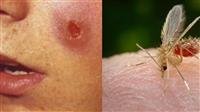
Cutaneous leishmaniasis, or what is known as "eastern ulcers", is prevalent in Libya, which is a seasonal disease and causes skin deformities in the absence of urgent treatment, because the area of skin ulcers causing damage to the skin always continues. While medical sources say that parasitoid leishmaniasis is transmitted by pinch the sand fly, which is a very small insect that does not exceed a third of the size of a normal mosquito, it is yellow, and it leaps and increases its activity at night and does not make a sound, so it may sting a person without feeling it, and is transmitted by a fly Leishmania parasite sand by sucking it from the blood of the injured person (an animal or a dog like rodents) then passes it on to the blood of the next person, so it is transmitted to it, and the disease spreads in the agricultural and rural areas.
Cutaneous leishmaniasis appears after several weeks of sand fly bite in the form of small or large red beans and then ulcers appear, and stiff secretions are attached to its surface, and these ulcers do not heal quickly, and ulcers gradually increase, especially in the case of weakening of the human immune system, and these lesions usually appear In open areas of the body, the recovery period ranges from six months to a year.
Since 2007, Libya has succeeded in eradicating leishmaniasis through several national programs to combat the disease, after it recorded 2341 cases during 2005, while the number of cases of eastern ulcers reached 1877 cases in the year 2006 in the northwest of the country. There is no national program to fight leishmaniasis, and disease control depends on rodent and sandfly control, "he said, noting that there is" administrative complexity in the documentary cycle of opening credits to supply the drug. "
According to the World Health Organization, the number of annual infections with leishmaniasis globally exceeds 1.3 million, and deaths are between 20 and 30 thousand annually. The health sector in the country suffers from a near complete collapse in the past years due to the lack of government financial allocations, in addition to leaving most of the medical and medical personnel aiding foreigners due to the deteriorating security situation.
Ahmed al-Qarari, director of joint diseases at the National Center for Disease Control, explains that the budget for the Leishmaniasis Program has been stalled for years, which has led to the absence of periodic control of the places where the disease is endemic.
On the readiness of the control center to face the crisis, he said, "We have a team and a plan of action that is fully prepared to deal with the outbreak, with a prepared and equipped plan in cooperation with the World Health Organization, in addition to our professional cadres ready from the place."
The disease center stopped dealing directly with the English manufacturer of the drug, which the center director attributed to «debts with this company on the Libyan state», and a shipment of medicines from Italy, including 5,000 injections of cutaneous leishmaniasis, is scheduled to arrive within ten days to Tripoli, according to statements Issued by the Ministry of Health.
Meanwhile, the spokesperson for the Ministry of Health of the National Accord Government, Amin Al Hashemi, revealed the fact that the shipment of medicines from India to treat leishmaniasis was rejected, and the Drug Control Center refused the shipment because it did not meet the specifications. In statements to Al-Wasat, he explained that the Ministry of Health turned to the Ministry of Foreign Affairs to address all Libyan embassies abroad in order to obtain a drug stored in the manufacturers, because the medicine is manufactured according to the order.
Al-Hashemi pointed out that “some Indian companies store leishmaniasis drugs, and they have sent 95 experimental syringes, a 100-millimeter package from Indian factories, through the Libyan embassy in India.” The Drug Control Center examined the shipment after its arrival in the country, and it was found that it is used to treat another type of Leishmania is not in Libya.
In turn, the director of the Center for Disease Control said: “There are limited Indian companies accredited to the World Health Organization, and they are making a second-class drug for leishmaniasis,” but added, “Unfortunately, the medicine brought by the Ministry of Health is not specifications and has impurities, as well as the manufacturer is unknown to World Health Organization". He noted that the technical specifications and medicines required to treat the disease are with the Ministry of Health and the Medical Supply Center regarding the urgency in supplying the drug, adding that "government agencies procrastinate because of the lack of funds to supply the drug."