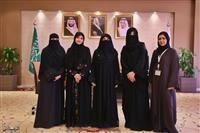
Taif University Council
Taif University took an important step towards enabling its female leaders to participate in decision-making, after it raised the number of women in the university council to 6 out of a total of 25 members, giving them greater representation and influence in making its decisions.
The percentage of women who occupy the membership of the Taif University Council is the largest ever compared to the university boards in the Kingdom, with the exception of Noura bint Abdulrahman University, which is a fully female university, and it is also similar to the percentage that women currently occupy in the membership of the Shura Council.
The University of Taif announced the issuance of the decision of the Minister of Education, Dr. Ahmed bin Muhammad Al-Issa, approving the nominations of its director, Dr. Hussam bin Abdul-Wahab Zaman, to appoint a new vice-chancellor for female students ’affairs, and to assign a dean for university studies, as well as appointing two deans whose responsibilities include both male and female students, in addition to other decisions. From the university president to appoint three heads of departments in different colleges.
The decisions issued included the appointment of Dr. Iman bint Saad Al-Zahrani as the vice-chancellor of the university for female student affairs, the appointment of Dr. Sarah bint Jazaa Al-Otaibi as the dean for the Deanship of Library Affairs, the assignment of Dr. Haifa Al-Nafiei as the dean for university studies (the university intends to convert the deanship to the deanship of international communication), in addition to the appointment of Dr. Rana bint Ghazi Zaini, Dean of the College of Community Service and Continuing Education.
The new decisions, issued in conjunction with the celebration of International Women''s Day last Thursday, raised the number of deans at the university to six, as Dr. Dalal Bint Mohiuddin Namangani was previously appointed dean of the College of Medicine, and thus became the first dean of a college that includes faculty members and students of both sexes in The Kingdom, as well as assigning Dr. Hind Bint Saleh Abdul Ghaffar, Dean of the College of Design and Applied Arts, to allow them to participate actively in decision-making.
The decision coincided with the approval of the Minister of Education, Dr.Ahmed bin Muhammad Al-Issa, last Sunday, to assign 14 Saudi women from the faculty to work as university agents for female students'' affairs for a period of three years, in the framework of contributing to the realization of the Kingdom''s vision 2030 in relation to women, and providing support to them through Developing their talents and energies, and enabling them to participate at the level of decision-making at the level of governmental institutions.
The Director of Taif University also issued decisions appointing Dr. Ibaa Bint Marawan Filemban as Head of the Nursing Department at the College of Applied Medical Sciences, Dr. Ibtihal Bint Yaqoub Khoja, Head of the Food and Nutrition Sciences Department at the College of Science, and finally Dr. Rasha bint Abdul Rahman Fallata, Head of the Accounting Department at the College of Business Administration.
The appointment of new female leaders at Taif University reflects the commitment announced by its director, Dr. Hussam bin Abdul Wahhab Zaman, through his confirmation during the annual meeting with the employees of the technical and administrative staff at the university recently: “The university’s policy is pursuing in accordance with the Kingdom’s Vision 2030 to empower Saudi women in academic and administrative positions.” As well as his emphasis on relying on the criteria of scientific merit and competence, and their primacy on the gender difference between faculty members.
The Kingdom''s Vision 2030 stated that "Saudi women are an important component of our strength, as they constitute more than (50%) of the total number of university graduates." Stressing that the state will continue to "develop its talents, invest its energies, and enable it to obtain appropriate opportunities to build its future and contribute to the development of our society and our economy."
The new vice president for female student affairs at the university, Dr. Iman bint Saad Al-Zahrani, held the position of Vice-Dean of Scientific Research and Associate Professor in Analytical Chemistry until the decision to appoint her in her new position was issued. The Okaz Innovation Award 2017.
As for Dr. Sarah Bint Jazaa Al-Otaibi, until the decision to appoint her as Dean of Library Affairs was issued, she held the position of Dean of University Studies, which is the highest leadership position previously held by women at the university. University of Southampton, UK in 2014.
While the Acting Dean of University Studies, Dr. Haifa Abdullah Al-Nafiei, worked as the Vice-Dean of the College of Community Service and Continuing Education until her new assignment, and she is also an assistant professor for the “Applied Linguistics” major in the Department of Foreign Languages at the College of Arts at the University, and she obtained a PhD in Applied Linguistics from the University British Newcastle in the year 2013.
Whereas, the Dean of the College of Community Service and Continuing Education, Dr. Rana Bint Ghazi Zaini, is an assistant professor at the College of Applied Medical Sciences, and she holds a PhD in Hematology from Sheffield Halm University in Britain in 2013.
The new decisions to enable women leaders to participate in decision-making at the level of Taif University come in the context of the developmental steps that the university has witnessed since the appointment of Dr. Hussam bin Abdul Wahhab Zaman as its director less than two years ago, which included the completion of the programmatic and digital transformation projects, and the launch of the Taif initiative again. In addition to its previous initiatives, most notably the restructuring of university agencies, empowering a number of young people to lead administrative positions and development projects, based on the criteria of merit and competence, creating the first cultural development department in Saudi universities, and assigning its management to a woman, Dr. Amal Al-Qathami.