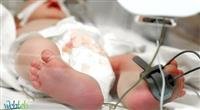

The inguinal hernias are those hernias that occur in the area when the upper thigh comes in contact with the lower abdomen, and it is the case most in need of surgery in infancy, and it occurs at a rate of (10-20) per thousand live births, and affects males four times as much as females, Half of its cases appear before the age of one year of age, and most of them are seen in the first six months of the infant’s life, and these hernias are found on the right side in (60%) of cases, and on the left in (30%), and they are bilateral in (10%), as for premature infants or premature infants, their test was large, up to (30%).
Most of these hernias result from the persistence of a connection between the abdominal cavity and the inguinal canal towards the scrotum in males and the labia in females, and the failure of this diverticula to fuse or contact completely leads to a complete hernia, while its blockage in the distal region and its proximal part remaining passable leads to a hernia called In direct and it represents most of the cases, as for its obstruction from a nearby location without the distant one, it leads to what is called a hydrocele in the testicle, and blockage near and far below the middle results in a spermicidal cord.
The hernia appears as a bulge in the top of the thigh below the abdomen and protrudes forward or into the scrotum where the testicle is, and sometimes the swelling occurs in the scrotum without a previous swelling higher than that, and the parents are usually the first to see the hernia during a crying episode of the child or during his clenching. The matter is naturally apparent during the infant''s sleep, rest or relaxation, and it is also not uncommon to hear a story from parents they tell with amazement about a deceptive swelling that appears and disappears from time to time in the groin area or in the scrotum in the male or in the labia in the female, and sometimes the hernia appears suddenly In a baby, it is accompanied by discomfort, or it may be accompanied by vomiting, flatulence and other signs that direct the doctor towards intestinal obstruction, and the skilled pancake can discover a hernia by simply placing the child in a suitable position, and for older children, just standing may make the hernia pop out of his nest. In any case, the hernia should be separated from the testicle or from other problems, in order to avoid an unjustified process.
Hernia abounds in certain families, and it is more common in children who suffer from a disease called fibrocystic fibrosis or who have a dislocated congenital hip or testicle not descending or suffer from vague genitals or hypospadias or upper urethra or have fluid collection inside the abdomen (haben), or defects Congenital in the abdominal wall, as may lead to whooping cough, and its abundance has been observed in medicines that affect connective tissue such as Ehlers-Danlos syndrome and mucopolysaccharid syndromes such as Hunter-Hurler, and if a hernia is found in a female, we must look for a disorder called testicular femininity because the hernia It is found in (50%) of cases of this disorder.
As for the treatment, it is surgery as soon as possible to avoid complications, including hernia strangulation, especially in the first year, and the operation is simple, and the patient can immediately after that leave the house, and he maintains hospitalization for those who have additional risks of heart or respiratory or other. The hydrocele in the testicle often heals on its own during the first year, and there is no surgery except for the cord cord that is often accompanied by a hernia, and if the hydrocele continues beyond the year, it is often a hernia that needs to be treated.
And about the complications of these hernias, we mention the contents being stuck in them and the subsequent blockage of the intestine with vomiting, constipation and flatulence, and the ovaries may become stuck in females, and any other organ may get stuck inside the abdomen, and as soon as the blood supply to the organ is disturbed, what we call suffocation occurs. Which calls for emergency surgery, and impaction occurs in (9-20%) of cases, especially in the first year of life, and it is frequent in females and premature infants, and it appears as a constant painful mass, and the child''s mood is disturbed and he cannot tolerate breastfeeding and cries severely , And the skin over the lump can swell or change its color a little, but it does not reddish and does not hurt as it happens with a strangulated hernia, and in these cases the hernia should be restored conservatively, and this results in (95%) of cases, and it is unusual that Emergency surgery is required in these cases, and after the response and within a day or two, the surgery is performed after the edema has subsided, as for asphyxia, the heart speeds up, fever occurs, and the hernia becomes red and becomes more painful, and there is no escape from immediate surgery despite this scarcity.
The results of surgery in infants and children are excellent, and its complications do not exceed (2%), and the hernia does not recur except in less than (1%) of cases.
And a word about preterm infants: (70%) of males at a gestation age less than (30) weeks have an inguinal hernia compared to (0.6%) only after the thirty-sixth week of pregnancy, with a weight less than (1.5) kg. Hernia occurs at a rate equivalent to (20) times more than in older infants, and they have a more frequent impaction of the hernia contents and may suffocate, and therefore the operation is performed for them before they are discharged from the hospital, and even after the operation, an idiopathic respiratory arrest has been observed, and of course it is necessary Manage it and remedy it.
Inguinal hernia is a simple matter and its treatment is simpler, by God, praise be to God, but it is not permissible for us as families and health personnel to ignore or forget it because by doing so we make the child an unjustified victim, despite his appearance sometimes and his absence at other times, the fact remains that he is there waiting for the skilled scalpel to transfer a tear. God willing....