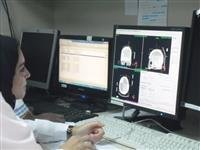
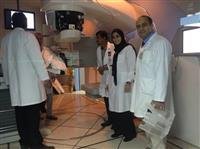
By the grace of God and his success, the medical team treated under the supervision of Dr. Rolina Kamal Al-Wasia, Assistant Professor and Consultant of Radiation Oncology at King Abdul Aziz University, and Dr. Yasser Abdul Aziz Bahader, Head of the Radiology Department at King Abdulaziz University, Jeddah, succeeded with the medical physics team and therapeutic radiologists in his first treatment A case of a secondary brain tumor, using the three-dimensional surgical radiation technology, and the treatment was one focused session to destroy three small tumor masses, ranging in size between 1.5-1.9 cm, for a 56-year-old patient who stayed 4 hours after treatment for observation and left the hospital in good condition And stable condition.
Radiation therapy is used to treat brain tumors a lot and it is usually after the removal of the tumor and in other cases when surgery is not possible due to the location of the tumor in sensitive areas in the brain or its presence at a depth that makes it difficult to reach it surgically, then radiotherapy is the best treatment, it causes damage A tumor''s DNA stops its cells from multiplying and causes its tissues to die.
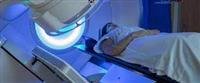
3D surgical radiation: Stereotachtic Radio-surgery, SRS is a type of radiation therapy that treats the patient very precisely due to the technique that is used to place the patient''s head in a special position inside a specific mask for this purpose, this mask is used To locate the tumor in three dimensions inside the brain, and the other reason for calling it the three-dimensional surgical radiation is that we use a high radiation dose and its focus in one session, its effect on the tumor is similar to surgery.
Three-dimensional surgical radiation can either be prescribed as a single focused dose called SRS, Stereotachtic Radiosurgery, or in a few sessions (FSRT Fractionated stereotachtic radiotherapy) instead of multiple doses of the usual radiotherapy.
The concentration of the dose is described according to the diagnosis of the condition and according to studied international recommendations, which have been published in a documented international medical journals where the effectiveness of the treatment and the probability of its side effects are accurately proven. And this type of treatment is prescribed for benign tumors or for malignant tumors.
Cases that require treatment with 3D surgical radiation technology are
Small deep brain tumors that are not surgically accessible, whether they result from brain tissue or are secondary from a tumor originating elsewhere in the body.
Brain tumors after partial surgical resection.
Tumors of the pituitary gland.
Benign skull fundic tumors, Shwannoma
Eye cancer, Choroidal Melanoma
Arteriovenous malformations (tangled blood vessels that leak and disrupt normal flow)
Neurological problems, such as trigeminal neuralgia.
Parkinson''s disease
A focus in the brain that causes epilepsy