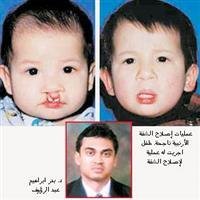
Successful plastic surgeries for children with cleft lip and cleft palate. Bader Ibrahim Abdul-Raouf to Al-Sharq al-Awsat: A child in every thousand is born with cleft lip. Jeddah: “Asharq Al-Awsat” Cases of cleft lip and cleft palate are among the most common birth defects in the face area. The degree of the incision varies from a small incision in the red part of the lip to a complete separation of the lip, and the fissure may also extend to that part of the bone, where the teeth grow through the gums, and the lip may be cleft on one side only or in both. The majority of mothers who have had children who suffer from cleft lip are concerned about their children, and they may wonder whether this deformity can be surgically repaired to make my child''s shape appear normal? Asharq Al-Awsat raised this issue with many questions to the consultant of plastic and prosthetic surgery at King Faisal Specialist Hospital and Research Center in Jeddah, Dr. Badr Ibrahim Abdul-Raouf, so he had the following dialogue:
How do the lips and the roof of its throat form while it is in its mother''s womb?
The fetus''s face begins to grow approximately seven to nine weeks after pregnancy, as the lips begin to grow first, then the hard and soft palate. The lip grows independently of the palate, so it is possible for a cleft to occur in the lip alone or in the palate alone or in both.
What is the incidence of cleft lip and what is the role of genetics?
In general, cleft lip occurs in one child from every 600 to 1000 children. Genetics plays a role in it, for example the presence of a child or one of the parents with a cleft lip, increases the risk of infection for children in the future by 2 to 4 percent.
What are the types of cleft lip?
The cleft lip may be partial or complete if the gum and upper jaw have a cleft or not. In addition, the cleft lip may be on one side only or on both sides.
What is the relationship of cleft roof of the mouth cleft lip?
In many cases, the child born with cleft lip has birth defects on the roof of the mouth. This may also be partial or complete.
Lip augmentation
Why is cleft lip plastic surgery so sensitive?
The cleft lip plastic surgery is considered an important and very sensitive event for the child for more than one reason, including:
The importance of the shape of the lip and mouth from a cosmetic point of view.
How thin and small these tissues are in a child.
The process needs accurate calculations during the operation, as any slight error may become apparent as the child grows.
What is the appropriate age for cleft lip augmentation? Why?
It is preferable to undergo cleft lip plastic surgery after the age of three months, as it was found that at this age the hemoglobin rate and the child''s weight had improved. They are two important factors to reduce the percentage of complications that may result. In addition, at this age, the tissues of the lip have grown enough for the surgeon to operate.
What is done during the cosmetic operation?
The main objectives of the process are
Lip length adjustment.
Releasing the lip muscles from their abnormal position and returning them to their normal position.
Adjustment of the nose.
The effects of the operation are not noticeable.
What is the effect of the cleft lip on the nose?
The cleft lip is also associated with a congenital deformity in the nose, and the reason for this is the adhesion of the muscles of the mouth to the nose in an abnormal position, thus causing the change in the shape of the cartilages of the nose, and also to the reflux of the half-nasal septum, which may lead to shortness of breath as the child grows.
Nose and mouth
What is the best age for rhinoplasty in a child with cleft lip?
The nose must be repaired during the cleft lip surgery, that is, at the age of three months, and this guarantees the best results. But the child may need another nose job, almost at the age of four, in addition to that, some patients need another nose operation, after the age of eighteen, that is, after the completion of facial growth.
What are the types of cleft roof of the mouth and their effects on growth?
Like the cleft lip, it may be partial or complete, and it may also be on one side of the roof of the mouth or on both sides. Congenital anomalies on the roof of the mouth do not affect the child''s development. The main reason for the repair of the roof of the mouth is the need for normal speech. As for the optimal age for the operation, it is when the child reaches one year of age, as it is at this age that the development of the speech center in the brain begins.
The roof of the mouth may require a second operation to repair any remaining gaps, which may occur in 15%. As for the expected results for the child''s speech after the success of the restoration of the roof of the mouth, they are that one third of these children will not need any other treatment to improve speech, and the second third of them will need training in proper speech, and the last third may also need another operation to improve speech. .
Children''s pronunciation
How is the child''s speech evaluated?
The child is referred to a specialist or speech therapist, and the child may need color rays and video imaging of the larynx during speech or to make a speculum through the nose. As for the occurrence of speech problems, it is due to the failure of the muscles of the roof of the mouth to touch the back wall of the throat during speech, and this leads to air leakage from the nose and leads to tinnitus during speech or (dementia).
What are the surgical methods that are used to treat these speech problems?
There are two main methods, either extending the roof of the mouth until it reaches the larynx wall, or making a connection between the roof of the mouth and the larynx wall.
What if there is a gap in the gums?
A gap in the gum may weaken the tooth of the canine, so it is recommended to repair this gap with a patch taken from the bone in general after the age of seven.
What are the other specialties that are involved in treating children with congenital malformations such as cleft lip and deformities of the roof of the mouth?
In addition to the specialty of reconstructive and cosmetic surgery, there are a number of important specialties: they are ear, nose and throat, speech and hearing, jaw surgery, teeth, orthodontics, pediatrics and genetics, in addition to a specialist or social worker.