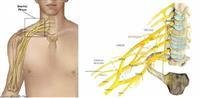
Brachial plexitis .. excruciating pain that continues even at rest! The brachial plexus is a grouping of nerves that extend from the neck to cross the shoulder region to the arm and forearm. This is a story of a patient who came with her husband to the clinic complaining of severe pain in the neck and shoulder region and extending to the humerus and forearm, which lasted for a few weeks, but it increased in the few days that Prior to her visit to the clinic. Upon examining the patient, severe pain was found in the left upper limb, her inability to move, and pain when trying to move the arm. This patient had been operated on to remove a herniated disc in the cervical vertebrae on the grounds that this was her cause and the cause of her pain, and this surgery took place a few weeks before her visit to the clinic. Upon reviewing the MRI before the operation and after the operation, it was found that the patient before the operation had a slight herniated disc in the cervical vertebrae and that it did not cause severe pressure on the nerves and that after the surgery the herniated disc was removed well and there were no complications in the rays that were performed after the operation. But the patient was still feeling the pain and she was confused and did not know why she would feel pain if the operation had been successful? Why did not her condition improve? To find out more information about her condition, a neuro-planning was requested for the left arm, and it was found that the patient suffers from brachial neuralgia. It was also found that the simple herniated disc that she had and that she was diagnosed with and the surgery was performed on the basis of it was not the cause of these pain and that the diagnosis was wrong and the surgery is not necessary because the pain and disease are the result of brachial plexitis.
Brachial plexus
The brachial plexus is a grouping of nerves that extend from the neck to cross the shoulder region to the arm and forearm and feed them and nourish the hand with sensation and movement. This plexus is called a plexus because it contains more than one nerve that extends from the small openings in the cervical spine, running from the front of the shoulder to the arm. This curl is of prime importance as it nourishes the hand and arm with sensation and movement.
Brachial plexitis
This inflammation (brachial neuralgia) occurs with or without a reason, but the causes may be due to a viral infection or as a result of an immune defect that causes the body to attack the nerve plexus, or in the vast majority of cases the inflammation is without cause. This inflammation leads to irritation and swelling of the nerves that make up this brachial plexus, which leads to a defect in its function and thus causes the symptoms that the patient or the patient complains of.
Symptoms and diagnosis
Usually, the patient complains of excruciating pain that extends from the bottom of the neck to the shoulder, arm and hand and varies in intensity from moderate to severe and continues even at rest (rest pain) and may be accompanied by a feeling of numbness or paresthesia in the fingers or difficulty in using the hand. And unlike the pain resulting from slipping Chondrosis in the cervical vertebrae, in which the pains usually depend on a specific situation and their intensity varies during the day and night, the inflammation of the nerve plexus leads to pain that continues during the day and at night, even with a lack of movement in the neck, shoulder and arm area. The patient may feel numbness in the arm, or he may describe the pain he feels as being like a burning sensation or a fire in his arm. The diagnosis is usually made after a clinical examination, which may indicate difficulty in moving the arm and hand and a lack of sensation in them. The magnetic resonance imaging is done to ensure that there are no slipped discs (cervical disc herniation) that compress the nerves and cause these pain and lead to confusion with the diagnosis of inflammation of the nerve plexus. Also, a nerve conduction study may be performed to show the presence of nerve plexitis and sometimes laboratory tests are performed. And the final diagnosis is through the clinical examination that we mentioned earlier, through nerve planning, and by making sure that there are no other causes that lead to these pain.
Treatment plan
These cases are usually referred to a consultant neurologist who is responsible for treating them, as the treatment does not require surgical intervention. In general, the treatment plan consists of taking adequate rest and giving anti-inflammatory drugs (NSAIDs), muscle relaxants and pain relievers. Often, cortisone is given for a period of days in a large dose to relieve the inflammation and pain caused by the nerve plexus. This drug is prescribed under the advice of a doctor and under the supervision of a doctor, and it is very useful and wonderful in the treatment of these cases, but it must be taken with caution and under the supervision of a doctor, and upon completion of treatment, the doses of the cortisone drug that is taken by mouth must be gradually reduced to avoid the possibility of side effects. The vast majority of patients respond beautifully to this treatment plan, the pain subsides, and the patient or patient returns to his or her normal life without the need for any kind of surgical intervention.
Tips and recommendations
These cases are rare, but when they do occur, the diagnosis must be carefully verified so that these cases are not mixed with other conditions such as a herniated disc and in order to avoid unnecessary surgical procedures that do not benefit the patient, but may expose him to the possibility of complications, God forbid.
Vitamin D deficiency "increases the chances of developing dementia" brachial plexitis .. excruciating pain that continues even when at rest! Eating .. After Ramadan! Discovery of a new virus living in the human intestine Double fractures .. Adherence to the treatment plan avoids permanent disability! 120 compounds in cabbage And the flower boosts immunity and restricts the growth of cancer cells