

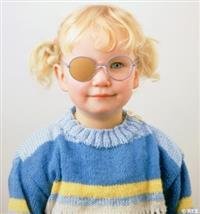
The younger the child, the faster the improvement and better results, 2/2 lazy eye .. Restricting the healthy eye stimulates the weak to do its job and the strength of vision improves! About the inner left eye d. Ahmed bin Abdul Razzaq Al-Saleh * In the last issue, we dealt with laziness of the eye, which is a condition characterized by poor eyesight as a result of little or no proper use of the eye in the early childhood years. In most cases, only one eye is affected or affected, and both eyes may become lazy. It is worth noting that the visual strength lost as a result of lazy eyes cannot be treated with medical glasses or any other treatment method if the child exceeds the years of developing the sense of vision.
To complete the topic, we ask an important question
Why is laziness eye an important issue?
The answer to that: If there is laziness in the eye, it is normal for you to not see clearly in at least one eye, and that also depends on the degree of laziness, whether it is large or not. It is true that one eye can be relied upon for vision, but nothing beats seeing clearly with both eyes. Also, slight degrees of laziness may deprive a person of three-dimensional vision, which leads to the impossibility of performing some of the delicate work required by some professions.
There is no doubt that if one eye is the one that carries out the full visual function, then this will expose the person to the risk of losing sight when suffering from eye diseases or accidents of that eye, God forbid.
Therefore, laziness of the eye is an important medical issue that must be taken care of, taken into account and treated at the right time.
What are the methods of treating lazy eye?
Treatment methods include the following
Correct and treat any of the aforementioned causes of lazy eye. Such as around the eye or correcting refractive defects (after or nearsightedness), removing cataracts if any, treatment of prolapsed eyelids if any.
Train the lazy eye to work well. So that the vision function is properly developed.
Correcting aetiology
Refractive defects such as farsightedness or nearsightedness can be corrected by using appropriate glasses, and this may take 4-6 months for the improvement to be evident, but if the cause is white water, it is necessary to surgically remove the cataract.
How can the lazy eye be urged to improve its function?
The main treatment for lazy eye is to restrict the function of a healthy eye, thus forcing or forcing the weak eye to do its job properly. In most cases, the strength of vision improves to an almost normal rate if this treatment is done early in the child''s life, as the visual improvement of that eye is achieved so that it can gradually catch up with the healthy eye.
The most common treatment method is to cover the healthy eye to stimulate the weak eye to see.
The eye lids are a light cotton membrane with adhesive edges that are attached to the orbit and the skin around the eye. The treatment period depends on the child''s age and the severity of the lazy eye, and the treatment period continues until the degree of vision returns to the normal range or until the improvement stops at a certain point. Follow-up visits with the specialist doctor are every three months, and when the improvement continues for a period of six months, the doctor begins to gradually reduce the coverage periods.
Eye covers to treat visual laziness
In the event that the cause of the laziness of the eye is white water, then the healthy eye must be covered after removing the cataract from the affected eye so that the coverage of the healthy eye is to the maximum extent until the age of seven years of the child The coverage hours are gradually coordinated by the attending physician to prevent the occurrence of laziness in the healthy eye. The entire treatment program with coverage may take from weeks to months, provided that it is from two to six hours coverage per day.
And the parents have to regularly visit the specialist doctor until the child completes approximately eight years of age to make sure that the weak eye is treated correctly and irreversibly. Where some doctors resort to preventive treatment coverage as needed.
Other methods of treating laziness include eye s or glasses, and some doctors may resort to eye s that cause the pupil to dilate (Atropine) and thus blurred vision in the healthy eye, and this type of treatment is suitable for uncooperative children and the effect of the is temporary, as it must be repeated Al-Ain several times a day, knowing that some parents find it difficult to place anything in the eyes of their child, but in terms of formality, it may be considered a better solution than coverage for this group of children. It is worth noting that this type of s may cause allergic reactions in the child, such as redness of the skin, acceleration in the heart rate and an increase in movement activity, which makes this type of treatment not desirable.
The treatment may be by using medical glasses whose lens is in front of the healthy eye with a high degree that causes blurred vision in the healthy eye and thus stimulates the weak eye to focus and work. And usually the glasses lens is frozen (or almost destroyed) so that the child cannot see through it, but the parents must convince the child first to wear the glasses!
As one of the most important defects of this method of treatment is that the child can see from above or under the glasses, which means not reaching the desired goal, which is temporarily impeding the function of the healthy eye and gradually stimulating the weak eye, and sometimes large-size contact lenses are used that impede the function of the eye. However, in early childhood, wearing and caring for contact lenses may be very difficult.
Visual physiotherapy is one of the assisting factors for the success of the coverage program, such as the use of games that require close focus, especially during daily coverage times, such as drawing, coloring, reading, and homework.
Important note: Some people may mistakenly think that the coverage treatment program means the correction of the squint, but it must be clear that the coverage treatment program aims to treat lazy eyes and improve vision and not correct the squint.
What are the future predictions for a lazy eye?
As a general rule, the younger the child is when lazy eye is detected and treated, the faster the improvement and the better the outcome for the growth of vision in the eye. If the treatment program begins before the age of 6-7 years of the child''s life, the probability of reconsidering normal function is greater. If treatment was started at an age older than 7 years, there may be some improvement, but the possibility of restoring complete visual function is rare.
Each child out of 4 suffers from a new occurrence of lazy eye after stopping the coverage treatment and the child is at risk of recurrence of laziness eye if treatment is stopped suddenly and incompletely.
Parents should know the necessity of adhering to the teachings of the specialist regarding eye coverage with great care and attention, because one of the main reasons for the failure of the eye coverage program is neglect of coverage hours and neglect of appointments with the doctor''s follow-up during the child''s growth and thus failure of the development of the optic nerve pathways. Therefore, it is necessary to quickly initiate treatment with coverage.
One final message for parents
Treating lazy eyes is not easy, as convincing the child to put the cap on is very difficult. Not to mention that the cap itself can be annoying and the child may attempt to lift and remove it. But if the family gives up, it will contribute to making the situation worse and the child may end up partially or completely blind.
Therefore, persuading the child to put the cover on and reward him when he is cooperating with a candy or a symbolic gift may facilitate the task for the parents.
Dr.. Ahmed bin Abdul Razzaq Al-Saleh *
Consultant ophthalmologist
Member of the Board of Directors of the Saudi Society of Ophthalmology
2-15-2011
Riyadh


