
implants
1. How does the sense of hearing work
The ear can be divided into three sections: the outer ear, the middle ear, and the inner ear.Each sound s vibrations in the air known as sound waves, the outer ear receives these sound waves first, which work in a similar way to the channel so that they collect and direct the sound waves, and the eardrum is located at the point where the ear meets The outer and middle ear, which vibrate as a result of sound waves and move the auditory ossicles in the middle ear known as the hammer, anvil, and stirrups, which transmit sound vibrations to the inner ear and to the cochlea - a spiral channel, there is fluid in the cochlea and hair cells, the hair cells move with the movement of the fluid, which leads to the generation of electrical impulses received by The auditory nerve transmits it to the brain where it is translated.
2. What is a cochlear implant?
A cochlear implant replaces the non-functional parts of the inner ear. In areas where there are no sensory hair cells, the device stimulates the nerve fibers directly inside the cochlea using electrical impulses.
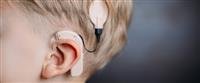
The cochlear implant system consists of two parts: the inner part which is the implant and the outer part which is the sound processor, the implant device is placed under the skin behind the ear and the electrode (electrode) of the implant is placed in the cochlea, and the sound processor is placed outside the head over the implant site using a magnet, and the processor receives the sound signals and sends them Electronically to the implant.
The electrode, consisting of several flexible polar arrays, is placed inside the cochlea so that the auditory nerve is stimulated, which in turn sends the sound information to the brain, and the polar arrays are covered with medical silicon and ceramic and medical titanium are used for the case, and all materials are biocompatible, which means that the body is able to bear it Very well.
3. What is the difference between cochlear implants and hearing aids?
Hearing aids and cochlear implants are mainly suitable for treating hearing loss, however, the technique and application of each differ radically.
Hearing aids amplify sounds and reduce surrounding noise for people with mild or moderate hearing loss. In contrast, cochlear implants are designed for people who suffer from severe to profound sensorineural hearing loss, which are cases where the hair cells in the inner ear are damaged and therefore not They can hear sounds as they should, and cochlear implants overcome these damaged hair cells and send electrical signals to the brain that are interpreted as sound.
Amplifying sounds with hearing aids is not sufficient if parts of the ear are damaged. Cochlear implants help restore hearing and cover its full range.
4. When is a cochlear implant necessary?
A cochlear implant is a potential solution for people with severe to profound sensorineural hearing loss. In each case, a team specialized in the field of otolaryngology and audiology evaluates whether a cochlear implant is appropriate or not.
A person must be in good health for a cochlear implant, and the person’s age is not an important factor from a medical point of view, whether the patient is a one-year-old child or a 95-year-old person. Another important factor is how long the patient has been suffering from hearing loss. The general rule is that the faster the patient implants the cochlear implant, the better the outcome.
For children, a cochlear implant can be beneficial if the brain is able to process incoming signals. To achieve this, the corresponding parts of the brain should have been formed in the early stages of development, which means that the child makes the most of early implantation at an age between The six months and two years, but this does not mean that a cochlear implant is completely excluded in later periods.
5. What is the cost of a cochlear implant?
The total cost of a cochlear implant depends greatly on your country of residence, the health system, and your insurance. However, the total cost inclusive of operations and rehabilitation is comparable to that of an average car. In most countries, the National Health Service covers cochlear implants, pre-operative evaluation, surgery, and follow-up treatment. Private insurance companies may cover all or part of the costs of cochlear implant treatment.
In general, it is recommended that additional information regarding charging the cost be obtained from a local audiologist or insurance company.
6. What does the world look like with a cochlear implant?
Immediately after the transplant, speech appears unnatural, empty and monotonous, and it is difficult to distinguish between individual sounds, so having auditory training is of great importance after the operation, and after going through an adaptation phase and making some adjustments to the acoustic therapist by an audiologist, hearing will improve significantly .
In the long term, cochlear implants stated that in the end speech hardly differs from normal speech while some noticed any difference at all. Listening to music is another challenge as the brain needs to learn to distinguish between individual sounds and pitches, and this usually takes longer than accustomed to speaking.
7. Why is auditory training important?
While eyeglasses correct your vision immediately, it is not that easy with a cochlear implant. A cochlear implant alone does not guarantee that you will be able to understand speech. Hearing should be practiced first, and this is done by obtaining specialized auditory training that begins after seizure. A sound therapist several weeks after the operation. During training, implant users learn to recognize single words and sounds even with ambient noises, use the phone and practice listening to music.
The rehabilitation period for each person depends on several factors, including their motivation and commitment to training. For adults, the rehabilitation process takes from six to 12 months, while the rehabilitation process for infants and children takes several years.
You should have realistic expectations when making a cochlear implant decision. A cochlear implant improves hearing, but it does not fully compensate for hearing loss, especially in complex situations, such as: when there is loud noise around a person.