What are congenital heart defects?
Congenital means present at birth. Congenital heart defects (also called CHDs) are heart conditions that a baby is born with. These conditions can affect the heart’s shape or how it works or both. CHDs can be mild or serious.
CHDs are the most common types of birth defects. Birth defects are structural changes present at birth that can affect almost any part of the body. They may affect how the body looks, works or both. Birth defects can cause problems in overall health, how the body develops or how the body works.
Critical congenital heart defects (also called critical CHDs or critical congenital heart disease) are the most serious congenital heart defects. Babies with critical CHDs need surgery or other treatment within the first year of life. Without treatment, critical CHDs can cause serious health problems and death.
Nearly 1 in 100 babies (about 1 percent or 40,000 babies) is born with a heart defect in the United States each year. About 1 in 4 babies born with a heart defect (about 25 percent) has a critical CHD. Some heart defects don’t need treatment or can be treated easily. But others, like some critical CHDs, may need surgeries over several years.
How can heart defects affect your baby?
Heart defects can affect different parts of your baby’s heart, including
Heart chambers. The heart has four chambers. The two upper chambers (also called atria) receive blood. The two lower chambers (also called ventricles) pump blood out of the heart to other parts of the body.
Septum. This is a wall that separates the right and left sides of the heart. There is a wall between the two atria, and a wall between the two ventricles.
Heart valves. These valves open and close to control blood flow through the heart. They help blood move in the right direction as it’s pumped to other parts of the body.
Arteries and veins near the heart. Arteries are blood vessels that carry blood away from the heart to the body. The aorta is the main artery that carries blood away from the heart to the rest of the body. Veins are blood vessels that carry blood from the body to the heart.
Heart defects can affect blood flow, causing your baby’s blood to
Slow down
Go in the wrong direction or to the wrong place
Be blocked
Not have enough oxygen to carry throughout the body
Some of these blood flow problems can cause fluid buildup in the lungs (also called lung congestion or pulmonary edema). Fluid in the lungs can make it harder for your baby to breathe. Babies with serious heart defects may develop heart failure (also called congestive heart failure). This is when the heart can’t pump blood as well as it should.
What are examples of critical CHDs?
Critical CHDs include
Coarctation of the aorta (also called COA). In this condition, part of the aorta is too narrow. This can reduce or block the flow of blood to the body. The heart muscles need to work harder to get blood out of the heart. This extra stress on the heart can weaken the heart muscle and cause other heart problems. Babies with COA are treated with surgery or a procedure called balloon angioplasty. In this procedure, a provider uses a catheter (a thin, flexible tube) with a tiny balloon that he expands to stretch open the aorta. He may put in a stent, which is a small mesh-covered tube used to keep the blood vessel open. Many children with COA need to take medicine to lower their blood pressure. Blood pressure is the force of blood against the walls of the arteries.
Dextro-Transposition of the Great Arteries (also called d-TGA). Babies with this condition have the positions of two important arteries switched. This means the blood that’s pumped to the body may not have enough oxygen. Babies with d-TGA need heart surgery soon after birth to help get oxygen-rich blood from the heart to the rest of the body. They may need medicines to make their heart pump better, lower their blood pressure, help the body get rid of extra fluid or slow down the heart if it’s beating too fast. If the heart is beating too slowly, they may need a pacemaker. A pacemaker is a small device placed under the skin in the chest to help control the heartbeat.
Interrupted aortic arch (also called IAA). In this condition, a part of the aorta is missing. This means that the heart can’t send blood through the aorta to the rest of the body. Babies with IAA need surgery soon after birth to repair the aorta.
Pulmonary atresia (also called PA). In this condition, the heart’s pulmonary valve doesn’t form properly or at all. The pulmonary valve controls blood flow from the right ventricle of the heart to the lungs. If a baby has PA, blood can’t flow from the heart to the lungs to pick up oxygen for the body. Babies with PA usually need medicine to improve blood flow until they can be treated with cardiac catheterization or surgery. During cardiac catheterization, your baby’s provider moves a catheter into a blood vessel and guides it to his heart. Then he can use a tiny balloon to expand the valve. Or he may put in a stent to keep a blood vessel open. But most babies with PA need surgery soon after birth to widen or replace the pulmonary valve.
Single ventricle defects. In this group of conditions, a baby’s heart has one ventricle that works well enough to pump blood instead of two ventricles. Single ventricle defects include:
Ebstein anomaly. In this condition, the heart’s tricuspid valve (the valve between the two right chambers of the heart) doesn’t work properly. This means blood can leak back into the wrong part of the heart. Babies with this condition may need surgery to repair or replace the tricuspid valve. They also may need medicines to control their heart rate, improve blood flow or treat any signs of heart failure.
Hypoplastic left heart syndrome (also called HLHS). In this condition, the left side of the heart doesn’t form correctly, and the heart can’t pump blood to the body properly. A baby with HLHS needs several different types of surgery starting soon after birth to help increase blood flow to her body. Some babies also need medicines to make their heart muscle stronger, lower their blood pressure or help the body get rid of extra fluid. If the condition is very severe or if surgeries weaken the heart, the baby may need a heart transplant. A heart transplant is surgery in which a damaged heart is removed and replaced with a healthy heart from another person.
Tricuspid atresia. In this condition, the heart’s tricuspid valve (the valve between the two right chambers of the heart) isn’t formed. This means that blood can’t flow correctly through the heart or to the rest of the body. Babies with tricuspid atresia may need one or more surgeries starting soon after birth to increase blood flow to the lungs and bypass (go around) the part of the heart that’s not working properly. Some babies need medicines to make the heart muscle stronger, lower their blood pressure, or help the body get rid of extra fluid.
Double-outlet right ventricle (also called DORV). In this condition, the aorta connects to the heart’s right ventricle instead of the left ventricle. There’s also a hole between the two ventricles. This means that the blood being pumped to the body may not have enough oxygen. Babies with DORV need surgery to repair the heart.
Tetralogy of Fallot (also called TOF). Babies with this condition have a combination of four heart defects that limits oxygen in blood that’s pumped to the body. Babies with TOF need heart surgery soon after birth to improve blood flow to the lungs and the rest of the body.
Total anomalous pulmonary venous return (also called TAPVR). In this condition, the veins that take blood from the lungs to the heart don’t connect to the heart the right way, so the body doesn’t get enough oxygen. Babies with this condition need surgery so that blood can flow better through the heart.
Truncus arteriosus (also called common truncus). Babies with this condition have only one artery that leaves the heart instead of two arteries. They also have only one valve that controls the blood that leaves the heart instead of two valves. This means that blood with oxygen mixes with blood that doesn’t have oxygen. So too much blood goes to the lungs, and the heart has to work harder to pump blood to the rest of the body. Babies with this condition need surgery to repair the heart and blood vessels. Some babies may need medicines to make the heart muscle stronger, lower their blood pressure or help the body get rid of extra fluid.
As they grow older, most babies with critical CHDs need regular checkups with a pediatric cardiologist to check the heart and look for any other health problems.
What are common congenital heart defects and how are they treated?
Common CHDs include
Patent ductus arteriosus (also called PDA). This condition happens in the connection (called the ductus arteriosus) between two major blood vessels leading from the heart: the pulmonary artery and the aorta. The ductus arteriosus is open when a baby is in the womb. If it doesn’t close properly after birth, blood that doesn’t have enough oxygen can flow in the wrong direction. This can weaken the heart muscle and lead to heart failure. Sometimes a PDA may close on its own. But some babies need medicine, procedures with catheters or heart surgery.
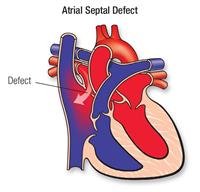
Septal defects. These conditions leave a hole in the septum. This can cause blood to go in the wrong direction or to the wrong place, or it can cause extra blood to be pumped to the lungs. Types of septal defects include:
Atrial septal defect (also called ASD). This is when the hole is in the wall that separates the right and left atria.
Ventricular septal defect (also called VSD). This is when the hole is in the wall that separates the right and left ventricles. VSDs are the most common type of heart defect.
Atrioventricular septal defect (AVSD). This is when there are holes between the chambers of the right and left side of the heart, and the valves between these chambers may not form correctly.
Some small septal defects close on their own. Heart surgery or procedures with catheters can fix larger septal defects. Babies with AVSD usually need heart surgery.
What causes congenital heart defects?
Heart defects can begin to develop in the first 6 weeks of pregnancy when the heart is forming, often before you know you’re pregnant. We’re not sure what causes most congenital heart defects, but these things may play a role:
Changes in genes or chromosomes
Some babies have heart defects because of changes in their chromosomes or genes. Chromosomes are the structures that hold genes. Genes are part of your body’s cells that store instructions for the way your body grows and works. Genes are passed from parents to children. Certain gene changes (also called mutations) are linked to heart defects. At least 15 in 100 (15 percent) of CHDs are linked to genetic or chromosomal conditions. For example, about half of babies with Down syndrome have heart defects.
If you, your partner or one of your other children has a congenital heart defect, your next baby may be more likely to have one, too. So you may want to meet with a genetic counselor. This is a person who is trained to help you understand genes, birth defects and other medical conditions that run in families, and how they can affect your health and your baby’s health.
Health conditions in mom
Having one of these conditions may increase your risk of having a baby with a CHD
Lupus (also called systemic lupus erythematosus or SLE). Lupus is an autoimmune disease. This is a health condition that happen when antibodies (cells in the body that fight off infections) attack healthy tissue by mistake. Lupus can damage the joints, skin, kidneys, heart, lungs and other body parts.
Maternal phenylketonuri