Peripheral artery angioplasty (say "puh-RIFF-er-rull AR-ter-ree ANN-jee-oh-plass-tee") is a procedure to treat peripheral arterial disease of the legs. The procedure widens narrowed arteries in the pelvis or legs. It can help blood flow better. This may decrease leg pain or help wounds heal better.
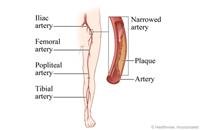
Your arteries can get narrowed by a substance called plaque. Plaque is a buildup of fats in your arteries.
You will be awake for the procedure. You will get medicine to prevent pain and help you relax. First, your doctor will do a test to find narrowed arteries. He or she will put a tiny tube into an artery in your groin or leg. This tube is called a catheter. The doctor moves the catheter through the artery and puts a dye into it. The dye makes your arteries show up on X-ray pictures. This lets the doctor see any narrowed parts of the arteries.
If your doctor finds a narrowed artery, he or she may do an angioplasty. To do this, the doctor uses a catheter with a balloon at the tip. It goes into the artery in your groin or leg. He or she moves the balloon to the narrowed area and inflates it. The balloon presses the plaque against the walls of the artery. This makes more room for blood to flow. The doctor may also put a stent in your artery. A stent is a small tube that helps keep the artery open. It can also keep small pieces of plaque from breaking off and causing problems.
You may need to spend the night in the hospital. For 1 or 2 days after the procedure, you will need to take it easy at home.
How It Is Done
Angioplasty is used to open narrowed arteries and increase oxygen-rich blood flow to muscle and tissue. These images show angioplasty for the iliac artery. Angioplasty can also be done for the femoral, popliteal, and tibial arteries.
What to Expect
After the procedure, pressure will be applied to the area where the catheter was put into your blood vessel. Then the area may be covered with a bandage or a compression device. This will prevent bleeding. Nurses will check your heart rate and blood pressure. The nurse will also check the catheter site for bleeding.
You will need to lie still and keep your leg straight for several hours. The nurse may put a weighted bag on your leg to keep it still.
You may have to stay overnight in the hospital. After you leave the hospital, you can most likely return to normal activities. You may have a bruise or a small lump where the catheter was put in your blood vessel. This is normal and will go away.
Why It Is Done
This procedure is commonly used to open narrowed arteries that supply blood flow to the heart. It may be used on short sections of narrowed arteries in people who have peripheral arterial disease (PAD).footnote 1, footnote 2
How Well It Works
Peripheral artery angioplasty can restore blood flow and relieve intermittent claudication.footnote 2, footnote 1 Angioplasty may help you walk farther without leg pain than you did before the procedure.footnote 3
How well angioplasty works depends on the size of the blood vessel, the length of blood vessel affected, and whether the blood vessel is completely blocked.
In general, angioplasty works best in
Larger arteries.
Arteries with short narrowed areas.
Narrowed, not blocked, arteries.
Risks
Complications related to the catheter include
Pain, swelling, and tenderness at the catheter ion site.
Irritation of the vein by the catheter (superficial thrombophlebitis).
Bleeding at the catheter site.
A bruise where the catheter was ed. This usually goes away in a few days.
Serious complications are rare. These complications may include
Sudden closure of the artery.
Blood clots.
A small tear in the inner lining of the artery.
An allergic reaction to the contrast material used to view the arteries.
Kidney damage. In rare cases, the contrast material can damage the kidneys, possibly causing kidney failure.
Radiation risk
There is always a slight risk of damage to cells or tissues from being exposed to any radiation, including the low levels of X-ray used for this test. But the risk of damage from the X-rays is usually very low compared with the potential benefits of the test.