
How does kidney disease affect children?
Kidney disease can affect children in various ways, ranging from treatable disorders without long-term consequences to life-threatening conditions. Acute kidney disease develops suddenly, lasts a short time, and can be serious with long-lasting consequences or may go away completely once the underlying cause has been treated. Chronic kidney disease (CKD) does not go away with treatment and tends to get worse over time. CKD eventually leads to kidney failure, described as end-stage kidney disease or ESRD when treated with a kidney transplant or blood-filtering treatments called dialysis.
Children with CKD or kidney failure face many challenges, which can include
a negative self-image
relationship problems
behavior problems
learning problems
trouble concentrating
delayed language skills development
delayed motor skills development
Children with CKD may grow at a slower rate than their peers, and urinary incontinence—the loss of bladder control, which results in the accidental loss of urine—is common.
More information is provided in the NIDDK health topic, Caring for a Child with Kidney Disease.
What are the kidneys and what do they do?
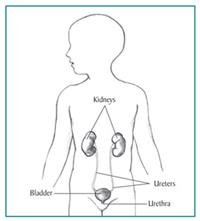
The kidneys are two bean-shaped organs, each about the size of a fist. They are located just below the rib cage, one on each side of the spine. Every day, the two kidneys filter about 120 to 150 quarts of blood to produce about 1 to 2 quarts of urine, composed of wastes and extra fluid. Children produce less urine than adults and the amount produced depends on their age. The kidneys work around the clock a person does not control what they do. Ureters are the thin tubes of muscle—one on each side of the bladder—that carry urine from each of the kidneys to the bladder. The bladder stores urine until the person finds an appropriate time and place to urinate.
The kidney is not one large filter. Each kidney is made up of about a million filtering units called nephrons. Each nephron filters a small amount of blood. The nephron includes a filter, called a glomerulus, and a tubule. The nephrons work through a two-step process. The glomerulus lets fluid and waste products pass through it however, it prevents blood cells and large molecules, mostly proteins, from passing. The filtered fluid then passes through the tubule, which changes the fluid by sending needed minerals back to the bloodstream and removing wastes. The final product becomes urine.
The kidneys also control the level of minerals such as sodium, phosphorus, and potassium in the body, and produce an important hormone to prevent anemia. Anemia is a condition in which the number of red blood cells is less than normal, resulting in less oxygen carried to the body’s cells.
What are the causes of kidney disease in children?
Kidney disease in children can be caused by
birth defects
hereditary diseases
infection
nephrotic syndrome
systemic diseases
trauma
urine blockage or reflux
From birth to age 4, birth defects and hereditary diseases are the leading causes of kidney failure. Between ages 5 and 14, kidney failure is most commonly caused by hereditary diseases, nephrotic syndrome, and systemic diseases. Between ages 15 and 19, diseases that affect the glomeruli are the leading cause of kidney failure, and hereditary diseases become less common.1
Birth Defects
A birth defect is a problem that happens while a baby is developing in the mother’s womb. Birth defects that affect the kidneys include renal agenesis, renal dysplasia, and ectopic kidney, to name a few. These defects are abnormalities of size, structure, or position of the kidneys:
renal agenesis—children born with only one kidney
renal dysplasia—children born with both kidneys, yet one does not function
ectopic kidney—children born with a kidney that is located below, above, or on the opposite side of its usual position
In general, children with these conditions lead full, healthy lives. However, some children with renal agenesis or renal dysplasia are at increased risk for developing kidney disease.
Hereditary Diseases
Hereditary kidney diseases are illnesses passed from parent to child through the genes. One example is polycystic kidney disease (PKD), characterized by many grapelike clusters of fluid-filled cysts—abnormal sacs—that make both kidneys larger over time. These cysts take over and destroy working kidney tissue. Another hereditary disease is Alport syndrome, which is caused by a mutation in a gene for a type of protein called collagen that makes up the glomeruli. The condition leads to scarring of the kidneys. Alport syndrome generally develops in early childhood and is more serious in boys than in girls. The condition can lead to hearing and vision problems in addition to kidney disease.
Infection
Hemolytic uremic syndrome and acute post-streptococcal glomerulonephritis are kidney diseases that can develop in a child after an infection.
Hemolytic uremic syndrome is a rare disease that is often caused by the Escherichia coli (E. coli) bacterium found in contaminated foods, such as meat, dairy products, and juice. Hemolytic uremic syndrome develops when E. coli bacteria lodged in the digestive tract make toxins that enter the bloodstream. The toxins start to destroy red blood cells and damage the lining of the blood vessels, including the glomeruli. Most children who get an E. coli infection have vomiting, stomach cramps, and bloody diarrhea for 2 to 3 days. Children who develop hemolytic uremic syndrome become pale, tired, and irritable. Hemolytic uremic syndrome can lead to kidney failure in some children.
Post-streptococcal glomerulonephritis can occur after an episode of strep throat or a skin infection. The Streptococcus bacterium does not attack the kidneys directly instead, the infection may stimulate the immune system to overproduce antibodies. Antibodies are proteins made by the immune system. The immune system protects people from infection by identifying and destroying bacteria, viruses, and other potentially harmful foreign substances. When the extra antibodies circulate in the blood and finally deposit in the glomeruli, the kidneys can be damaged. Most cases of post-streptococcal glomerulonephritis develop 1 to 3 weeks after an untreated infection, though it may be as long as 6 weeks. Post-streptococcal glomerulonephritis lasts only a brief time and the kidneys usually recover. In a few cases, kidney damage may be permanent.
Nephrotic Syndrome
Nephrotic syndrome is a collection of symptoms that indicate kidney damage. Nephrotic syndrome includes all of the following conditions:
albuminuria—when a person’s urine contains an elevated level of albumin, a protein typically found in the blood
hyperlipidemia—higher-than-normal fat and cholesterol levels in the blood
edema—swelling, usually in the legs, feet, or ankles and less often in the hands or face
hypoalbuminemia—low levels of albumin in the blood
Nephrotic syndrome in children can be caused by the following conditions
Minimal change disease is a condition characterized by damage to the glomeruli that can be seen only with an electron microscope, which shows tiny details better than any other type of microscope. The cause of minimal change disease is unknown some health care providers think it may occur after allergic reactions, vaccinations, and viral infections.
Focal segmental glomerulosclerosis is scarring in scattered regions of the kidney, typically limited to a small number of glomeruli.
Membranoproliferative glomerulonephritis is a group of autoimmune diseases that cause antibodies to build up on a membrane in the kidney. Autoimmune diseases cause the body’s immune system to attack the body’s own cells and organs.
Systemic Diseases
Systemic diseases, such as systemic lupus erythematosus (SLE or lupus) and diabetes, involve many organs or the whole body, including the kidneys:
Lupus nephritis is kidney inflammation caused by SLE, which is an autoimmune disease.
Diabetes leads to elevated levels of blood glucose, also called blood sugar, which scar the kidneys and increase the speed at which blood flows into the kidneys. Faster blood flow strains the glomeruli, decreasing their ability to filter blood, and raises blood pressure. Kidney disease caused by diabetes is called diabetic kidney disease. While diabetes is the number one cause of kidney failure in adults, it is an uncommon cause during childhood.
Trauma
Traumas such as burns, dehydration, bleeding, injury, or surgery can cause very low blood pressure, which decreases blood flow to the kidneys. Low blood flow can result in acute kidney failure.
Urine Blockage or Reflux
When a blockage develops between the kidneys and the urethra, urine can back up into the kidneys and cause damage. Reflux—urine flowing from the bladder up to the kidney—happens when the valve between the bladder and the ureter does not close all the way.
How is kidney disease in children diagnosed?
A health care provider diagnoses kidney disease in children by completing a physical exam, asking for a medical history, and reviewing signs and symptoms. To confirm diagnosis, the health care provider may order one or more of the following tests:
Dipstick test for albumin. The presence of albumin in urine is a sign that the kidneys may be damaged. Albumin in urine can be detected with a dipstick test performed on a urine sample. The urine sample is collected in a special container in a health care provider’s office or a commercial facility and can be tested in the same location or sent to a lab for analysis. With a dipstick test, a nurse or technician places a strip of chemically treated paper, called a dipstick, into the person’s urine sample. Patches on the dipstick change color when albumin is present in urine.
Urine albumin-to-creatinine ratio. A more precise measurement, such as a urine albumin-to-creatinine ratio, may be necessary to confirm kidney disease. Unlike a dipstick test for albumin, a urine albumin-to-creatinine ratio—the ratio between the amount of albumin and the amount of creatinine in urine—is not affected by variation in urine concentration.
Blood test. Blood drawn in a health care provider’s office and sent to a lab for analysis can be tested to estimate how much blood the kidneys filter each minute, called the estimated glomerular filtration rate or eGFR.
Imaging studies. Imaging studies provide pictures of the kidneys. The pictures help the health care provider see the size and shape of the kidneys and identify any abnormalities.
Kidney biopsy. Kidney biopsy is a procedure that involves taking a small piece of kidney tissue for examination with a microscope. Biopsy results show the cause of the kidney disease and extent of damage to the kidneys.
How is kidney disease in children treated?
Treatment for kidney disease in children depends on the cause of the illness. A child may be referred to a pediatric nephrologist—a doctor who specializes in treating kidney diseases and kidney failure in children—for treatment.
Children with a kidney disease that is causing high blood pressure may need to take medications to lower their blood pressure. Improving blood pressure can significantly slow the progression of kidney disease. The health care provider may prescribe
angiotensin-converting enzyme (ACE) inhibitors, which help relax blood vessels and make it easier for the heart to pump blood
angiotensin receptor blockers (ARBs), which help relax blood vessels and make it easier for the heart to pump blood
diuretics, medications that increase urine output
Many children require two or more medications to control their blood pressure other types of blood pressure medications may also be needed.
As kidney function declines, children may need treatment for anemia and growth failure. Anemia is treated with a hormone called erythropoietin, which stimu