Your Most Fertile Time
Ovulation symptoms aren''t difficult to notice. Once you know what to look for, you''ll be surprised how easy it can be. Just about every person trying to get pregnant wants to know when it''s ovulation day. Ovulation is when an egg is released from the ovary. When the egg is ovulated, you want sperm waiting in the fallopian tubes available to fertilize that egg.
In other words, ideally, sexual intercourse should occur before the moment of ovulation in order to increase your odds of conception. Women are most fertile in the days leading up to ovulation.1 If you can have sex during this time, your chances of getting pregnant that cycle will go up considerably.
How can you know which are your most fertile days? Here’s how to find out when ovulation is approaching and how to know if it has already occurred. Also, learn how can you tell if you’re not ovulating and what to expect if you’re not.
The Ovulation Window
On average, a woman with regular cycles tends to ovulate sometime between day 11 and day 21 of her cycle. (Day 1 is the day you get your period.) This means a woman’s most fertile days will fall somewhere between day 8 and day 21.2
If your cycles are on the shorter side, you’re more likely to ovulate closer to day 11. If you have longer menstrual cycles, ovulation may occur closer to day 21. But “some time” between day 11 and day 21 is quite a long range.
You could aim to have sex every day or every other day between day 8 and day 21. Or, you can look for ovulation symptoms and have sex whenever you detect fertile signs. You can also try tracking your cycles every month, so you get an idea of when ovulation occurs for you (your own personal average).
Some ovulation signs indicate that ovulation is approaching. This allows you to time sex for pregnancy. Others let you know that ovulation has passed. This can be reassuring, giving you confidence that you did ovulate.
Signs of Ovulation
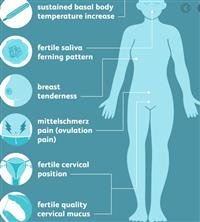
Determining your exact ovulation day can be tricky, but there are several ways to tell when you''re at your most fertile point in your cycle. Here are eight signs that ovulation is coming or that ovulation has just occurred.
A Positive Result on an Ovulation Test
An ovulation predictor kit works a lot like an at-home pregnancy test.3 You urinate on a stick or into a cup in which you place the stick or test strip. Two lines will appear. When the test line is darker than the control line, the test is considered positive, indicating that you are likely about to ovulate. This is the time to have sex to get pregnant.
Ovulation tests are a popular way to detect ovulation, but they have their pros and cons
They''re less work than charting your basal body temperature. (More on that below.)
Digital ovulation monitors can be relatively easy to use.
Simpler tests can be difficult to interpret as it''s not always easy to determine when the test line is darker than the control.
They can get expensive, especially if your periods are irregular or you’re trying to conceive for a long time.
They''re not a guaranteed sign you ovulated. You can get a positive result and not ovulate.
Women with polycystic ovarian syndrome (PCOS) may get multiple positive results, even if they aren’t ovulating, making the kits useless.
Fertile Cervical Mucus
When you’re approaching ovulation, secretions near the cervix known as cervical mucus increase and transform into a raw-egg-white-like consistency.3 This fertile quality cervical mucus helps sperm swim up and into the female reproductive system and makes sexual intercourse easier and more pleasurable.
When you’re not in a fertile stage of your cycle, cervical mucus is stickier. The stages of cervical mucus are almost-dry to none, sticky, creamy, watery, raw-egg-white-like, and then back to sticky or dry. You can learn to track these changes and predict ovulation.
When you have wet or egg-white-like cervical mucus, that’s the best time to have sex to get pregnant.
Increased Sexual Desire
Nature knows exactly how to get you to have sex at the ideal time for conception. A woman’s desire for sex increases just before ovulation. Not only does her desire for sex go up, but she also looks sexier. The actual bone structure of a woman’s face shifts slightly, her walk becomes sexier, and, if she dances, her hips have a more sensual swing.
If you’re in the mood, go ahead and get some horizontal baby dancing down. This is an easy way to time sex for pregnancy. Of course, ovulation isn’t the only thing that can have your libido soaring. Also, if you’re anxious, stressed, or depressed, you may not notice or have an increase in sexual desire, even right before ovulation.
Basal Body Temperature Increase
Your basal body temperature (BBT) is your temperature when you’re at rest. While you may think of a normal body temperature as 98.6 degrees Fahrenheit, the truth is that your body temperature varies slightly throughout the day and month. It goes up and down based on your activity level, what you eat, your hormones, your sleep habits, and, of course, if you get sick.
Some things you should know about tracking your BBT
Tracking requires you to take your temperature every morning, at the same time every morning (i.e., no sleeping in), before you get up to use the bathroom in the morning.
Free apps and websites can be used to chart your BBT.
Though it can''t predict ovulation, your BBT can tell you the approximate day ovulation occurred, after the fact.
Irregular schedules make tracking BBT difficult, such as working the night shift or inconsistencies in your sleep patterns.
Your doctor can diagnose irregular cycles or ovulation problems with your BBT chart.
After ovulation, progesterone levels rise in your body, which causes your temperature to rise slightly. If you track your BBT, you can see when you ovulated.3
Change in Cervical Position
If you think of your vagina as a tunnel, the tunnel ends at the cervix. Your cervix shifts positions and changes throughout your menstrual cycle.4 You can track these changes.
Just before ovulation, the cervix moves up higher (you may even have difficulty reaching it), becomes softer to the touch, and opens slightly. When you’re not in the fertile stage of your cycle, the cervix is lower, harder, and more closed.
While you may think cervix checking is limited to OB/GYNs during childbirth, it is something you can learn to do. And while you’re checking your cervix, you can evaluate your cervical mucus changes too.
Breast Tenderness
Ever notice that your breasts are sometimes tender to the touch? But not always? The hormones your body produces after ovulation cause this. You can use this change as a way of confirming that ovulation has likely occurred.5
You can’t predict ovulation this way, but it can be reassuring if you’re wondering if you’ve ovulated this cycle yet. That said, breast tenderness could also be a side effect of fertility drugs.
Saliva Ferning Pattern
A ferning pattern in your saliva is another possible sign of ovulation.3 A unique and uncommon way to detect ovulation, a ferning pattern looks like frost on a windowpane. There are specialized microscopes sold for this purpose but you could technically use any toy store microscope.
Some women have difficulty detecting the ferning pattern. Because it’s an unusual way of tracking ovulation, you won’t find many resources and peer support. (Unlike with cervical mucus or basal body temperature tracking, where there are many support forums from which you can receive feedback and guidance.)
Ovulation Pain
Ever notice a sharp pain in your lower abdomen that seems to occur randomly? If that pain comes mid-cycle, you may be experiencing ovulation pain.5
Some women get ovulation pain every month. Research has found that mid-cycle pain (also known as mittelschmerz, German for “middle pain”) occurs just before you ovulate, which would be when you’re most fertile.
For most, ovulation pain is a temporary sharp pain in the lower abdomen. However, others experience pain severe enough that it prevents them from having sexual intercourse during their most fertile time.
Tell your doctor right away if you are experiencing severe pain during ovulation, as this could be a possible symptom of endometriosis or pelvic adhesions.
Does the Exact Day of Ovulation Matter?
Can any of the ovulation signs listed above give you the exact date you ovulated? Here’s the bottom line: It doesn’t matter. As long as you have sex every day or every other day within three to four days of your possible ovulation date, you’ll have had sex at the right time to conceive. In fact, research has found that it may not be possible for you even to know the exact day you ovulated.
Ultrasound can be used to determine when ovulation occurred.3 Researchers have compared ultrasound results to commonly used methods of ovulation tracking. They found that basal body temperature charting correctly predicted the exact day of ovulation only 43% of the time. Ovulation predictor kits, which detect the LH hormone surge that occurs prior to ovulation, may be accurate just 60% of the time.
All of this is good news. It means you don’t need to stress out over having sex on the exact day before ovulation in order to conceive.
As long as you have sexual intercourse when there are possible fertile signs, or have sex frequently all month long, your odds of conceiving are good
Signs of Irregular Ovulation
If you’re not ovulating, however, you can’t get pregnant. And if you’re ovulating irregularly, it may be harder for you to conceive. Anovulation is the medical term for not ovulating.6 Oligovulation is the medical term for irregular ovulation. The following are some possible signs of an ovulation-related problem.
Irregular Cycles
If your periods are unpredictable, you may have an ovulation problem. It’s normal if your menstrual cycle varies by a couple days each month. It’s not normal if the variations span several days.
Very Short or Long Cycles
A "normal" cycle can be as short as 21 days or as long as 35 days. However, if your cycles are commonly shorter or longer than this, you may have an ovulation problem.
Missing Periods for Months or Longer
Assuming you’re of childbearing age, not getting your period at all or going many months between cycles, can both be strong signs that you’re not ovulating.
No Rise in Basal Body Temperature
As mentioned above, your basal body temperature rises slightly after ovulation. If you’ve been charting your cycles and you don’t get this increase in temperature, it’s possible you’re not ovulating. However, some women don’t get the rise in BBT, even if they are ovulating. Why this happens is unknown.
Also, irregular sleep patterns and not taking your temperature at the same time every morning before getting up for the day can throw off your charting results.
Inconsistencies in Ovulation Test Results
Ovulation test kits detect the hormone LH, which surges just before ovulation occurs. If you never get a positive result, you may not be ovulating.
Oddly enough, getting multiple positive results can also indicate an ovulation problem. This implies your body is attempting to trigger ovulation but is not achieving success. Think of it as a misfire. This is common in women with polycystic ovarian syndrome (PCOS).
Don’t assume you can’t get pregnant if you have symptoms of a possible ovulation problem. Even if you’re not getting your periods, it may still be possible to get pregnant. It’s unlikely. But it’s possible. If you don’t want to get pregnant, you need to use contraception or birth control. Talk to your doctor about your particular situation.
Ovulation and Fertility Tests
If you suspect you’re not ovulating or ovulating irregularly, see your doctor. You may have a fertility problem, and it’s important you get things