
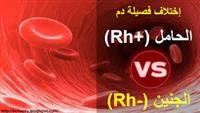
of the parents differ?
Blood type incompatibility Rhesus factor is one of the most important causes of intellectual disability that can be prevented, and its incidence has decreased now through examination and knowledge of the parents’ blood type, anticipation of the event before it occurs, as well as the discovery of an antibody therapist, and attention to careful monitoring of the pregnant mother and fetus after birth. .
Types of blood type
There are two types of blood
The main type of blood is A, B, AB, O
The Rh factor is Rh+ positive or Rh- negative, and it has been found that 80% of people carry the positive + trait in the Rh factor, and this is the dominant genetic trait, that is, it is positive in the fetus when it is present in one of the parents (mother, father).
For example, a person with blood type A and Rh+-positive Rehsus is called A+.
For example, a person with blood type A and Rh-negative Rh factor is called A-
And so are the rest of the species.
The difference in blood type between the mother and the fetus
The fetus acquires the blood type from its parents through genetic factors. If it acquired the trait from the father and it was different from the mother, there are several possibilities:
If the mother is Rh-positive, and the fetus is Rh-negative, then there is no problem for the fetus and child after birth.
If the mother has a negative trait (Rh-) and the fetus has a positive trait (Rh+), then there is an expected problem, which is the incompatibility of the blood type - rhesus factor, if there is a difference in the original blood type AB-AB-O between the child and the mother, there may be a problem Simple is not as dangerous as the previous case.
How do problems arise in blood type incompatibility - rhesus factor?
If the mother has a negative trait (Rh-) and the fetus has a positive trait (Rh+), then there is an expected problem, which is the incompatibility of the blood type - the rhesus factor, but the red blood cells do not move through the placenta, so how does the problem arise?
With a miscarriage or the first birth, there will be bleeding from the fetus''s blood, and some red blood cells are transmitted from the fetus to the mother through simple and very small wounds in the placenta and reproductive system.
These red blood cells contain the positive trait (Rh+), and then activate the mother''s immune system to remove these cells from the mother''s blood because they are considered foreign - a foreign body, and these antibodies remain in the mother''s body and in the memory of the immune system.
At the second birth, the mother’s body and her immune memory contain these antibodies, and the size of these antibodies is small, so they can cross through the placenta to reach the fetus, and then these antibodies attack the fetus’s blood (red blood cells) and break it down, which leads to multiple problems such as anemia Ascites, increased jaundice, nervous system poisoning, intellectual retardation, and others.
How can problems with blood type incompatibility - Rh factor be prevented?
Problems with blood type-Rh factor incompatibility can be prevented through good medical care, follow-up during pregnancy and before birth, and through the following points:
Follow up pregnancy
Knowing the mother’s blood type - it may be necessary to know the father’s blood type if the mother has a negative (Rh-) trait and the fetus has a positive (Rh+) trait, the mother must be given a special antibody to eliminate the antibodies produced by the mother, called Rhogam, after each Birth or miscarriage.
Follow-up of the fetus through ultrasound to determine the presence of complications or not, when there are complications, it may require early intervention during pregnancy in specialized centers, and it may need to change the blood of the fetus
Follow-up of the child after birth to find out the percentage of bile (jaundice) he has, through blood analysis:
When the percentage of bile (jaundice) rises to specific degrees, it may need to be placed under close supervision, such as placing it under a certain light (a special bulb, not an ordinary one), and it may need to make a blood change.
Why doesn''t the difference in the original blood type A-B-AB-O cause the same problem?
The answer is that the antibodies secreted by the immune system against this type are large in size, IGG, and thus cannot cross through the placenta, and therefore do not lead to problems in the fetus, but after birth it can lead to broken blood and jaundice, and it may be dangerous, but it is less dangerous than a different factor rhesus