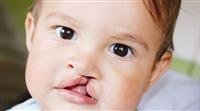
The cleft lip is a congenital defect that affects children at a rate of one child for every five thousand children, and sometimes it is accompanied by a cleft in the roof of the throat and this represents one child for every thousand children, and on this basis, if the number of births was one million children per year, we would have about 4 or 5 thousand cases annually. Affected by defects of the cleft lip.
Dr. Qadri Wishahi, Professor of Pediatric Surgery at Qasr Al-Ainy Medicine, says: The causes of infection are due to the genetic factor, with the presence of pollution factors that cause birth defects, or the mother’s taking of medications that are not allowed during pregnancy. It was found that folic acid during pregnancy reduces the incidence of cleft lip and when it is born. A child with a congenital defect “the cleft lip” is unable to absorb milk from the mother’s breast with the presence of a facial deformity. Previously, the cleft lip operation was performed from the age of 3 to 6 months before the teeth appeared and after making sure that there were no other congenital defects for the child, but now With the progress of surgery and the advancement of anesthesia and the emergence of
Surgical microscope and with the presence of ultrasound that diagnoses any other congenital defects, surgery can be performed in the first days of the child’s life, provided that he weighs more than three kilograms at birth with the presence of physiological yellow and often in the first week, and one of the advantages of performing surgery immediately after birth is that it enables The child from sucking milk from the mother’s breast and breastfeeding without the need for artificial milk, in addition to the fact that the scar that occurs after surgery “the surgical effect” at this age disappears quickly due to the rapid growth of the child and thus does not leave any traces on the face. From an aesthetic point of view, the result is much better than On the other hand, early surgery removes the psychological impact of the mother and family when the child is seen with this congenital deformity.
Dr. Qadri and Shahi recommends performing the surgery in the first days of the child''s life and not delaying it. Before the surgery, it must be performed
Blood, fluid, and bile blood tests to ensure that the child is fit for surgery. The mother breastfeeds the child an hour after the operation. The milk can be easily absorbed from the mother’s breast. Delaying the operation has a psychological effect on the family, and the scar after the operation is clear for some time and needs some creams and ointments to hide it. For a period of up to six months to a year, the mother must go early to a specialized pediatric surgeon to fix congenital defects and not delay them, as the results of the operation are better whenever the child is younger. The cleft lip operation is performed outside the fetus while it is in the mother’s womb in research centers Also, performing the operation in the first month causes wound healing as a result of cell proliferation, and this does not result in deformation after surgery, and after the first month, wound healing occurs through tissue fibrosis, in addition to that operations performed early are safe in children who have anal obstruction. Having an anus” or they have a blockage in the digestive system or they have a blockage in the esophagus and cannot eat normally or in children who have congenital defects in the spine and spinal cord or blockage of the stomach The ureters or the kidneys are all safe operations and their results are good in the first days of life.