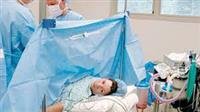
The recent switch to the technique of nerve blocking in the place where surgery is to be performed instead of full anesthesia, has significantly accelerated post-operative recovery, greatly helped in operating rooms, and halved the costs of post-operative medications.
During the past 3 years, nearly 1,000 different surgeries have been performed - including knee replacements and mastectomy - using nerve blocking anesthesia instead of full anesthesia. Thus, the patient has avoided full anesthesia and its side effects, such as the patient’s fasting, drowsiness and dizziness for a long time after the surgery. Repeated full anesthesia has also been associated with the risk of recurrence of some types of cancer and poor memory and information processing. In the case of local anesthesia, the patient can drink and eat immediately after the completion of the surgery. And a small study of patients at University College London Hospital, in which these surgeries were performed, found that patients now prefer local anaesthesia.
Anesthesia is carried out by stopping the feeling of peripheral nerves, and this is done inside a specialized room, and the patient is injected near a specific nerve or group of nerves to stop the feeling of pain in that area. Anesthesia lasts for a longer period compared to local anesthesia and is more often given in cases of surgeries of the arms, hands, feet, feet and face. When the tip of the needle touches the nerve, the patient feels a shock similar to an electric shock in the area that connects that nerve, and then the patient must tell the anesthesiologist about this. circulatory system or respiratory system This method benefits from anesthesia when performing surgery in certain areas of the body and in areas where it is difficult to use local anesthesia such as the face, for example, to avoid distortions.