
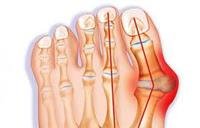
of the big toe in the foot?
Deviation of the big toe, or the so-called “bun” shaped bunion, is located on the big toe joint in nine cases out of ten in women. 15% of women after the age of 50 will suffer from hallux valgus, which is called in French as hallux valgus and in English as bunions.
advertisement
Heredity plays an important role in this condition, but the secondary causes that predispose to the appearance of hallux deviation are wearing high-heeled shoes and those that are narrow and uncomfortable.
Among the diseases that incite the development of the disease, we refer to gout or high uric acid in the blood, in addition to diseases of the autoimmune system. As a result of the increasing pain day after day, wearing shoes becomes difficult due to the severity of irritation of the skin area around the thumb.
Is surgery almost the only solution available to eliminate the painful formal defect in the big toe joint, or are there non-surgical middle solutions that restore the situation to normal within two months of special care?
In the past, surgery was the only way to restore luster to the big toe joint and eliminate the pain that prevents wearing shoes. But the surgery, regardless of its high cost and the pain after its completion, does not guarantee one hundred percent that the deformed bones will recover and in 39% of the cases who undergo surgery, the problem reappears after a few years.
For those who are worried about resorting to extreme surgical methods, experts have developed the Valgomed device, which is an elastic spacer bandage. This bandage aims to achieve a successful “reflexology” for hallux valgus by means of a corset method designed to position the big toe in the correct direction so that the pain and inflammation stop.
The spacer-elastic bandage is made of soft silicone and is designed to respect the anatomical shape of the foot and the uniform distribution of body weight when walking.
To achieve the desired therapeutic effect of the Valgomed dressing, it is required that it be used for a minimum of 6 to 10 hours per day. This bandage is not ugly and can be worn under socks.
In 2014, Valgomed was recognized as a major advance in the treatment of bunions in the toe joints. After recognizing the importance of this bandage, the need for surgical intervention was reduced by 70%.
Nowadays there are many similar products on the market, but their effectiveness compared to Valgomed is much lower.
To relieve chronic pain from hallux valgus and coexisting with bitter, the doctor may prescribe pain relievers such as non-steroidal anti-inflammatory drugs such as ibuprofen, provided that the woman is bound not to wear high heels and not very pointed or pointed shoes.