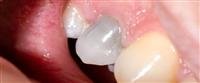
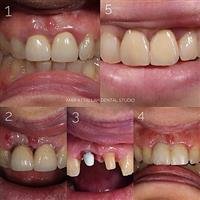
Fixed prosthodontics is an area of prosthodontics that focuses on permanent prosthodontics. These compensations, referred to as indirect restorations, also include crowns and bridges (fixed dentures), inlays and onlays, and veneers. Prosthodontics specialists are specialized dentists who have undergone training recognized by academic institutions in this field. Fixed prosthodontics can be used to restore one tooth or several teeth, extending to cover the entire areas where the tooth has been lost. In general, the main advantages of fixed prosthodontics over direct restorations are the superior strength when used to restore large areas, and their ability to an aesthetically pleasing tooth. As with any dental restoration, the principles used to determine the appropriate type of restoration include the type of materials used, the extent of tooth destruction, the direction and location of tooth growth, and the condition of adjacent teeth.
Setup techniques
Crowning involves the irreversible removal of a large portion of the tooth''s structure, and in comparison to a healthy, natural tooth, all restorations involve a weaker structural and functional structure. Therefore, it is usually not recommended to resort to dental prosthodontics unless based on the decision of the specialist dentist, and it is worth noting that dentists trained in different institutions, times, and countries prefer to use different methods of treatment, which leads to different and varied treatment guidelines to some extent, and crowning operations usually need and Bridges are more than a visit to the dentist, which can be considered one of the disadvantages of these compensations, but the many benefits of these procedures are worth the extra time they take.
Settings dimensions
The settings needed to prepare the tooth for crowning are usually entirely confined to the enamel. But in fact, the amount that needs to be removed from the tooth structure depends on the material used for the restoration If the tooth is crowned with a full gold crown, the thickness of the restoration is limited to 0.5 mm, because gold is very strong and needs a very small space of approximately 0.5 mm only for its installation. The addition of porcelain (porcelain) to the golden crown requires the removal of approximately 1 additional mm of the tooth structure, so the total is 1.5 mm of the thickness of the teeth to be removed, and porcelain or ceramic crowns require 2 mm of removal. Metal crowns also need 1 mm, and zirconia crowns need 1.5 - 2 mm.
The tooth may need building materials if the tooth structure is not sufficient to contain the artificial crown. This can be achieved with direct screw-on restorations, such as amalgam fillings (mercury-reinforced metal mixture), or resinous fillings (resin materials) such as fluorocor. More severe cases may require the use of wedges (stents) and hearts (nucleus). When following this method, endodontic therapy is recommended This is because the peg will lodge in the dead root canal to provide the necessary support for the crown. The tooth may also need to lengthen the crown due to the small area of the exposed tooth, and it is noted that the total material cost, effort, and time required for these various procedures, in addition to the low probability of success due to the combination of failure rates for each operation, makes resorting to extracting the tooth and replacing it with an artificial tooth more logical and abundant.
Taper degree
The prepared tooth must be tapered to a certain degree to allow for proper placement of prosthodontics. Essentially, the dental setup cannot have any lower cuts (axillary) because it would make it impossible to take the filling out of the mold and fit it into the tooth. At the same time, a large degree of taper will significantly reduce the stability of the crown on the prepared tooth, leading to failure of the restoration. In general, a taper of 6 degrees around the entire circumference of the tooth (leading to a total of 12 degrees taper in any sagittal section across the prepared tooth) is appropriate for a proper and stable crown installation.
margin
The most coronal position (ie, the continuous line of the original and non-etched tooth structure at or near the gum line) is indicated by the margin. This margin will be the future continuous line of contact between the tooth and the filling, so it must be smooth and well defined to allow the filling of any kind to fit with the tooth, and not to form any spaces visible to the naked eye, no matter how slight. The distance between the tooth margin and the filling margin is acceptable if it ranges between 40-100 nm, but the R.V. Tucker''s gold inlay produces a separation distance of only 2 nanometers, according to a scanning electron microscope, less than the diameter of a single germ.
The margin between the tooth and the filling is an ugly thing that should not be shown in the visible part of the tooth, to maintain the aesthetic when the tooth is in the area visible when smiling, so the dentist prefers when working in these areas to put the margin as far as possible apically (towards the terminal apex). to the root) even if it is below the gum line, yet several problems may result when it is placed far below the gum line, it may pose difficulties in determining the margin when taking the impression to make the stone model of the tooth. There is also a problem with biological presentation. where it defines biological presentation It is the mandatory distance to be left between the height of the alveolar bone and the filling margin, and if this distance is violated by placing the margin well below the gum line, dangerous repercussions will result. If it is not possible to position the margin apically enough to keep the artificial crown properly on the structure of the prepared tooth, the tooth or teeth concerned must undergo a crown lengthening procedure.
There are several different types of margins that can be used when restorations with a crown. including chamfer Which is commonly used in full gold fillings, because it removes the least possible amount of tooth structure. and there is the scapular margin Which removes more thickness of the dental structure to allow the placement of a thicker restorative filling such as porcelain on a PFM crown, or the placement of a full ceramic crown (see below for a detailed explanation of the types of crowns and their materials). The dentist advises adding a bulge (beveled edge) when using the scapular setting This is because the margin between the shoulder and the groin serves to effectively reduce the distance between the tooth and the filling when grouting the final filling.
Ferrule effect (supporting)
The most important consideration when restoring with a crown is the inclusion of a ferrule effect. As in the case of broom bristles that are enclosed in a collar when in contact with a broom stick, the crown must encapsulate a certain height of the tooth structure to prevent the tooth from breaking after it is prepared for the installation of the crown. The ferrule value was determined after multiple tests with a mandatory continuous circumference of 2 mm, and any value lower than this results in a very high failure rate for endodontically restored and crowned teeth. When the teeth are not endodontically treated, their remaining structure always provides the necessary 2 mm height of the ferrule, while the treatment of them is known to be very abrasive and lose a very large part of the dental structure. Contrary to popular belief, endodontically treated teeth are not fragile after their loss of vitality (death) according to the study of CM Sedglay & Messer in 1992 mentioned in the Journal of Endodontic Therapeutics, also the calcaneal (oblique edge) is not, as some doctors believe, is not suitable at all to apply the ferrule effect, As the tooth structure whose edge has been bent may not be covered by the necessary distance of 2 mm.
Types of restoration
the crown
A crown is used to cover a tooth and is commonly referred to as a cap. Typically, the dentist prepares the teeth for the crown and records are given to the dental technician to construct the prosthesis. The records include the models, which are exact copies of the patient''s teeth, and the impressions used to make these models. There are several different ways to make the crown, each of which uses different materials, and there are similar methods that use similar or identical materials. These materials include gold and other similar metals, porcelain, or a combination of the two. Zirconium oxide crowns are currently more popular due to their high transparency and durability, compared to porcelain crowns, which tend to crack.
the bridge
A bridge is used to cover or bridge a toothless area by attaching fixed restorations to adjacent teeth called abutments. The term bridge can refer to a fixed partial denture, which includes multiple units in one piece (several separate crowns joined together). The part of the bridge that replaces the missing tooth is known as the pontic (the pontic). In the case of the loss of several teeth, several bridges are used.
inlay
An inlay filling is a method of restoration that is restricted within the limits of the tooth cusps. These fillings are considered more conservative than onlay fillings, and crowns as they require the removal of less part of the tooth structure when preparing for them. This method is used when tooth damage is less than half the distance between the edges of the tooth''s cusp.
filling (onlay)
An onlay filling is a method of restoration that covers (protects) or reinforces one or more cusps, and is one method of indirect restoration of teeth. This method is usually used when tooth damage is extensive due to caries or trauma.
ceramic cladding
Veneers are a thin layer of prosthetic material placed over the surface of the teeth, either to improve the aesthetics of the teeth, or to restore the surface of damaged teeth. The materials used include porcelain and other compounds. In some cases, there is a need to remove part of the tooth structure to provide enough space for the veneer, while sometimes it can be attached to the teeth directly without prior preparation or removal.