
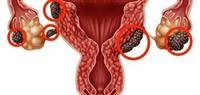
Many women of fertile age suffer from endometriosis, a disease in which the tissue of the inner lining of the uterus grows outside the uterus as well. This phenomenon is not always accompanied by specific symptoms, and it is not generally dangerous, but in some cases it may cause pain and other problems.
The tissue that grows outside the uterus is called the graft. These grafts generally grow on the ovaries, on the fallopian tubes, on the outer wall of the uterus, on the intestines and on other organs in the abdominal cavity. In very rare cases, these grafts can also extend to the organs outside the abdominal cavity.
Symptoms of endometriosis
The most common symptoms of endometriosis are
1. Pain
The pain appears in the places where the grafts grow and the pain may appear in the lower abdomen, in the rectum, in the vagina or in the lower part of the back, and these pains appear only before or during menstruation, and this pain intensifies in some women during sex, during defecation or when Ovulation is when the ovaries release eggs.
2. Unusual bleeding
In some women with endometriosis, heavy menstrual bleeding occurs with spotting or bleeding.
between menstrual periods
after sex
in urine or feces.
Endometriosis differs from one woman to another. Some women discover the disease only after they undergo a doctor’s examination as a result of their inability to become pregnant, and some women suffer from contractions and cramps that seem to them as a normal phenomenon, and some other women may suffer from severe bleeding and severe pain that prevents them From going about their normal lives to the point that they are unable to go to work or to study.
Causes and risk factors for endometriosis
Specialists do not yet know the reasons for the growth of endometrial tissue outside the uterus, but they know that the female hormone estrogen makes the problem worse and complicates, since the level of estrogen is high in women of fertile age, this is generally the period during which women suffer from erectile dysfunction uterine lining
During menopause or menopause, when estrogen levels begin to decline, endometriosis symptoms often disappear as well. Factors that increase the risk of endometriosis include:
1. Age
The disease mainly appears in the period between fertile age and menopause until the age of approximately 50 years, at the age of menopause, that is, when the level of estrogen hormone decreases, the possibility of endometriosis disappears.
In the past, it was believed that endometriosis could appear only several years after the onset of menstruation, but this belief was found to be wrong, as there are cases in which endometriosis appeared in girls who did not reach puberty after or after the appearance of the first menstruation directly.
2. Family history
The appearance of endometriosis in the mother or sister, i.e. first-degree kinship, increases the risk of severe endometriosis in the daughter or sister, and it seems that this risk is genetically transmitted from the mother.
3. Other risk factors
Other risk factors include
A menstrual cycle lasting less than 28 days.
Menstrual bleeding that lasts more than 7 days.
The onset of menstruation for the first time at an early age, before the age of 12 years.
Less than two full-term pregnancies, a full-term pregnancy lasts 37-42 weeks.
Abnormal structure of the uterus, cervix or vagina usually from birth, causing a blockage or slowing of blood flow.
Endometriosis complications
Complications include the following
Infertility and subfertility.
Chronic pelvic pain and subsequent impotence.
Anatomical disorders of the involved organ systems.
cancer.
Diagnosis of endometriosis
There are many factors that can cause severe menstrual pain or bleeding, so in order for the doctor to be able to diagnose endometriosis, he does the following:
Ask the patient about symptoms, menstruation, and the personal health history of the patient and the family, as endometriosis can sometimes be a genetic disease.
A pelvic exam may include an examination of the vagina and rectum.
If the doctor suspects endometriosis, then he recommends taking medication for a few months. If the patient''s condition improves after taking the medication, this may be evidence of endometriosis.
In order to detect an ovarian cyst, an ultrasound scan, computed tomography scan, or magnetic resonance imaging may sometimes be needed, as these tests show a picture of what is happening inside the abdominal cavity.
Despite the above tests, the only way to reach a confirmed diagnosis that the condition is actually endometriosis is a laparoscopy. In this procedure, the doctor makes a small incision in the abdomen through which a thin tube is ed that lights the abdominal cavity, and if the doctor sees During this process, scar tissue or cyst is removed immediately.
Endometriosis treatment
Endometriosis is not completely curable, but it can sometimes be cured. Getting the appropriate treatment requires trying several treatments. In each of these treatments, there is a chance that the symptoms of endometriosis will recur.
The treatment method is chosen according to the goal to be achieved. In some cases, the goal is to treat the pain and hide it only, while achieving pregnancy is the goal in other cases.
In order to stop the pain and bleeding, drug treatment or surgery can be adopted, but when a woman with endometriosis is interested in pregnancy, she may have to undergo surgery to remove the grafts growing outside the uterus.
Endometriosis treatments include
Pain relievers.
Contraceptive pills.
hormonal treatment
Laparoscopic surgery to remove grafts and scars.
In rare cases, in women who suffer from very severe pain, surgery can be resorted to to remove the uterus and ovaries, when the ovaries are removed, the estrogen level s sharply, which often leads to the disappearance of endometriosis symptoms, but this removal can lead to It also leads to the onset of menopause symptoms and the inability to become pregnant at a later time.
Women approaching menopause usually turn to drug therapy rather than surgery, because endometriosis is not a problem after menopause.
Prevention of endometriosis
There is no way to prevent endometriosis, and the reason for this is due to the fact that specialists do not know the causes of endometriosis, but the use of hormones to prevent pregnancy, whether by patches, tablets, or the IUD for a long period of time, can prevent the exacerbation of endometriosis.