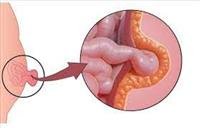
Many babies may have their navels sticking out when they cry. This is a classic sign of an umbilical hernia, which is a very common condition, but in most cases it is not serious. An umbilical hernia occurs when part of the intestine bulges through a weak area of the abdominal muscle. Umbilical hernia is a very common condition among children
infants, but it is also found in adults.
In most cases, the umbilical hernia closes on its own until the age of one year, but the recovery needs a longer period in about 10% of cases. In cases where the umbilical hernia does not disappear automatically until the age of 4 years, or when it appears at an advanced age, it is necessary to correct it by surgery, to prevent complications.
Symptoms of umbilical hernia
Hernia causes the following symptoms
A slight bulge or soft bump near the navel, usually one to five centimeters in diameter.
Watching umbilical hernia in infants while crying or just making an effort, and the protrusion may disappear when the child calms down, or when he lies on his back.
Abdominal discomfort in adults.
Causes and risk factors for umbilical hernia
Some people wonder why an umbilical hernia occurs, learn about it here.
The cause of the umbilical hernia
During pregnancy, the umbilical cord passes through a small opening in the baby''s abdominal muscle, and this opening closes before birth, but when the muscles do not meet completely and completely in the midline, a weak area develops in the abdominal wall, which can cause an umbilical hernia at birth, or later in life.
In adults, severe pressure in the abdominal area may lead to an umbilical hernia.
Factors that increase the risk of umbilical hernia
Among the factors that may cause severe pressure in the abdominal area
Obesity.
Heavy lifting.
Cough.
Multiple pregnancies.
Fluid in the abdomen (Ascites).
Multiple loads.
In general, hernia is a very common condition among children, especially premature babies, and among infants with low birth weight. Umbilical hernia may occur in both boys and girls.
Complications of umbilical hernia
Complications of umbilical hernia in children are rare, as the abdominal tissues remain trapped outside and fail to push into the abdominal cavity, thus reducing the blood supply to the trapped part.
Among the most important complications resulting from this
Navel pain and tissue damage in children.
Tissue entrapment and intestinal obstruction in adults.
Diagnosis of umbilical hernia
A hernia can be diagnosed by the following procedures
Physical examination.
blood tests
Imaging examinations are different, such as ultrasound, or X-ray.
Umbilical hernia treatment
In most cases, the umbilical hernia closes automatically until the age of one year, and in some cases the doctor can push the protrusion back into the abdomen, during a physical examination.
surgery
Surgery is used for children only in cases where the umbilical hernia is large and causes pain, or in the following cases:
The size of the hernia increases after the age of one or two years.
The hernia does not disappear after the age of four.
The protrusion is trapped or causes bowel obstruction.
As for adults, it is recommended to adopt surgery in general to avoid complications, especially in cases where the size of the hernia increases, or causes pain.
During hernia surgery, a small incision is made at the base of the navel, then the protruding tissue is returned to the abdominal cavity, then the incision is sutured and closed. Most people can go home a few hours after the surgery, and then return to normal life within two to four weeks. weeks.
It is unlikely that the umbilical hernia will reappear.
Prevention of umbilical hernia
Umbilical hernia can be prevented by
Doing sports to strengthen the abdominal muscles.
Follow a healthy diet.
Get rid of obesity.
Quit Smoking.
Chronic cough treatment.