
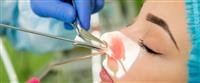
What is a nasal speculum? And what are its uses? Can it cause serious complications? Here is the answer to your questions about rhinoscopy in this article. In the following, let us learn about the most important points related to nasal endoscopy, in addition to a simplified explanation of the steps for performing nasal endoscopy, with a list of its most important diagnostic and non-diagnostic uses:
What is a nasal speculum?
Nasal endoscopy is a procedure used by a doctor to examine the inside of the nasal cavity for any problems or pathogens that may be affecting the nose, sinuses, and other nearby organs.
In fact, nasal endoscopy is performed using a small, flexible tube that has a very fine camera and a light source at one end.
The nasal endoscope enables the doctor to see the condition of the nasal cavity and the areas beyond the nasal cavity, such as: the throat, the pharynx, and the back of the tongue.
What are the uses of a nasal speculum?
Nasal endoscopy is a commonly used and relatively safe medical procedure that can be performed in a specialist doctor''s office or in emergency departments.
The uses of the nasal speculum are divided into several sections, and they include the following:
1. Using nasal endoscopy for the purpose of diagnosis
Rhinoscope is often used to diagnose and identify health problems related to the nose and paranasal sinuses, or peri-nasal areas Which includes:
Nasal congestion.
Pain and pressure in the face.
Increased nasal secretions.
Nasal obstruction.
epistaxis
Presence of nasal polyps (polyps).
Sinusitis.
loss of sense of smell
Eustachian tube obstruction.
Cerebrospinal fluid leak.
Nasal tumors.
Nasal endoscopy can be performed to take tissue or mucus samples from the nasal cavities, to complement other diagnostic tests, such as examining tissue under a microscope or performing a bacterial culture of mucus.
2. Using nasal endoscopy to evaluate treatment
The specialist doctor may recommend performing or re-performing nasal endoscopy to assess the patient''s response to treatment, for example:
Evaluation of the inflammatory state of the sinuses after treatment with drug therapies.
Evaluation of sinus condition or its complications after the surgical procedure.
Evaluation of the removal of polyps, or purulent secretions.
3. Using the nasal endoscopy technique for the purpose of treatment
Nasal endoscope is one of the successful and simple means of performing some surgeries related to the nasal cavity, as it does not cause damage to the patient''s external appearance compared to traditional surgeries. These operations may include:
Excision of polyps.
Excision of small tumors.
Sinusitis, to remove accumulated mucus.
4. Using the nasal endoscopy technique for the purpose of cleaning
Rhinoscope is also used in the following cases:
Rid the nasal cavity of foreign objects, especially very small children''s toys.
Cleaning the nasal cavity from the remnants of nasal surgeries, which include mucus or fibrin, which works to close the nasal cavities.
Suction of purulent mucous secretions.
Rhinoplasty procedure steps
The time period for performing nasal endoscopy requires 1-5 minutes, as the steps for nasal endoscopy include the following:
The patient sits on the examination chair in a normal sitting position.
The patient is given anesthesia and a decongestant to reduce swelling before starting the endoscopy.
The specialist doctor begins by ing the endoscope tube inside the nose, which contains at one end a camera that is technically connected to an external screen through which the internal images are displayed so that the doctor can complete the examination or procedure.
The doctor removes nasal polyps, small growths, or mucus.
Complications of nasal endoscopy
In general, complications arising from nasal endoscopy are rare, and these complications include the following:
Nosebleeds: People who take blood thinners are more likely to bleed.
An allergic reaction to the medications used during the endoscopy, such as: local anesthetics or decongestants.
Fainting. People with heart disease are more likely to faint.