
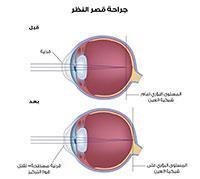
Laser eye surgery is a surgical technique that is used to correct vision in people who are very nearsighted, or have mild degrees of farsightedness. Robotic lamellar keratoplasty is a traditional method of surgery, but there are currently many laser eye procedures that are more precise.
Advantages of laser eye surgery
Compared to other surgeries to correct vision, laser eye operations are characterized by the following:
recover quickly.
Shorter vision stabilization time.
Disadvantages of laser eye surgery
Despite the advantages of laser eye surgery, it may carry some drawbacks, such as the following:
Less accuracy than other eye operations, which means that it is difficult to predict its outcome in advance.
Increased risk of astigmatism.
Side effects after laser eye surgery
There are some side effects of laser eye surgery, which are relatively rare, such as the following:
Glare.
Inability to use contact lenses.
eye infection
corneal scarring
prior to the operation
The eye is examined to determine the amount of deficiency or height in the patient, as the steps of the operation depend on this examination, and the patient must avoid wearing contact lenses for three weeks before surgery.
during the procedure
Laser eye surgery is performed under local anesthesia, and it usually takes less than one hour. The procedure is as follows:
Make a partial incision in the cornea, then gently fold the cut piece upwards to expose the underlying layer of tissue.
The surgeon cuts the layer under the cornea precisely based on the extent of the patient''s visual impairment.
The cornea is folded back and its tissue is put back in place, where it is supposed to heal and fuse automatically with the surrounding tissue.
Post-operation
The recovery time usually takes about a day, but the patient may need more time for his vision to stabilize, and the doctor usually prescribes some anti-inflammatory drugs to prevent the spread of infection.