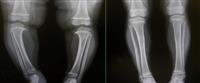
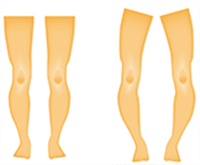
In fact, rotational deformities of the legs are a different disorder from angular deformities of the legs. Angular deformities of the legs Angular deformities of the lower extremities are common during childhood, and in most cases this represents a variation in the way of normal development, and is completely benign. The presence of angular abnormalities with no symptoms, joint stiffness, systemic disorders, or some types of benign syndromes indicates excellent long-term health outcomes.
However, non-angular deformities associated with pain, joint stiffness, systemic disorders, or syndromes may indicate a serious underlying cause and require treatment.
Little is known about the relationship between sports participation and body conditioning during development. Intense football participation increases the degree of variance in males starting at age 16, and predisposes individuals to more injuries.
Rotational deformities in the legs
Rotational malformations are common deformities of the lower extremities in children, and they include two main types:
In-toeing: It is caused by one of the three types of deformity: metatarsal convergence, tibia torsion of the inner leg, and increased femoral eversion.
Outward gait: It is less common than entry, and its causes are similar but opposite to the causes of entry, and include reflexion of the thigh, and torsion of the outer leg.
In most cases the deformity improves with time. Treatment is usually simple with the use of special shoes. Surgery is also reserved for older children with a deformity of three to four standard deviations from normal.
Symptoms of rotational and angular deformities in the legs
In fact, there are not many well-studied symptoms of rotational and angular deformities in the legs.
1. Symptoms of angular deformities in the legs
As mentioned earlier, the patient may not experience any symptoms, but in other cases, angular deformities may be accompanied by the following symptoms:
Joint stiffness.
disorders in various organs.
Some types of syndromes.
2. Symptoms of rotational deformities in the legs
In fact, the infected person does not show any obvious symptoms except for the way he walks, which may be inward or outward.
Causes and risk factors for rotational and angular deformities in the legs
There are many causes that lead to angular and rotational deformities, as follows
1. Causes of angular deformities in the legs
Among the most prominent causes of angular deformities in the legs are the following
The presence of the problem of knee varus (Genu varum).
Having a sick family history.
Asymmetric growth stops in the medial portion of the distal femur and proximal tibia due to exposure to infection, fracture, or tumor.
rickets
Vitamin D deficiency.
Bone dysplasia, such as Achon lasia.
Fibrochondral dysplasia.
Congenital longitudinal deficiency of the tibia with relative overgrowth of the fibula.
Lead or fluoride poisoning.
2. The causes of rotational deformities in the legs
Angular deformities in the legs occur through the following
bone deformities
Neuromuscular disorders.
Dislocations and spasms of soft tissues.
Complications of rotational and angular deformities in the legs
There are no studied complications of angular and rotational deformities of the legs.
Diagnosis of rotational and angular deformities in the legs
Malformations are diagnosed as follows
1. Diagnosis of angular deformities of the legs
Diagnosis is made by following these steps
physical examination
The doctor conducts a physical examination of the disease to detect symptoms and signs that indicate the presence of angular deformities in the legs. The patient is also asked about the family history of the disease.
Laboratory tests
The doctor usually checks the level of vitamin D and phosphate in the body in the event of rickets or bone deformities.
Imaging examinations
Imaging tests are usually performed in the following cases
The child is 3 years of age or older with a vagal knee that has not improved with time.
When bowing the two sides are not symmetrical.
The location of the acute angular curvature is in the proximal tibial metaphysis just below the knee.
Other clinical findings indicated the possibility of a comorbid condition, such as
Short stature due to skeletal dysplasia.
Epiphyseal hypertrophy.
A history of trauma or infection.
The short tibia and the relatively long fibula.
Having a history of possible metal poisoning with lead or fluoride.
2. Diagnosis of rotational deformities of the two legs
The diagnosis is made as follows
Clinical examination: which is to determine the patient''s ability to stand, walk, and run.
Neuromuscular examination: This is very important for the diagnosis.
Imaging examination: Computed tomography is often done.
Treatment of rotational and angular deformities in the legs
The treatment varies according to the type of deformity that the patient faces, as follows
1. Treatment of angular deformities in the legs
Treatment varies according to the patient’s condition and the cause, as follows
Treating the cause of the disease
Some abnormalities, such as: rickets, can simply be corrected with drug therapy by using calcium and vitamin D supplements.
Using a Dennis Brown splint
When a severe sprain is associated with a moderately severe shin sprain and the angle is 11 degrees or more, a Dennis Brown splint is prescribed with the feet rotated laterally and with an 8-10 inch tape between the shoes.
This is usually worn at night only for no more than 3-6 months in order to correct a sprain.
surgical intervention
In adolescents with an acute zygoma with marked impairment of the mechanical axis of the lower extremities it is sometimes indicated that tibia osteotomy, distal femur muscle dislocation, or proximal tibia fusion are sometimes indicated to correct the deformity.
2. Treatment of rotational deformities of the two legs
The best way to treat rotational deformities of the lower extremity in children is a correct diagnosis followed by determination of the level and severity of the disease.
It is worth noting that the in-gait often deteriorates gradually when the lower limb rotates outward with age, and a medical shoe or insole may seem of no value in this regard, and the open night splint has limited use, and it is not recommended to wear it within hours Further waking up has not had a proven long term benefit to date.
99% of rotational abnormalities improve spontaneously, and surgical intervention is required in only 1% after the age of 8-10 years.
Prevention of rotational and angular deformities in the legs
There are no special ways to prevent infection with these deformities except to treat the causes of the disease as soon as possible, and early diagnosis may help reduce the exacerbation of the disease.