
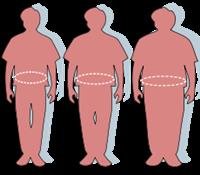
Obesity is a medical condition in which excess body fat has accumulated to the extent that it may have a negative effect on health, leading to reduced life expectancy and/or increased health problems.[1][2] In Western countries, people are considered obese when their body mass index (BMI),[3] a measurement obtained by dividing a person's weight by the square of the person's height, exceeds 30 kg/m2, with the range 25-30 kg/m2 defined as overweight. Some East Asian countries use stricter criteria.
Obesity increases the likelihood of various diseases, particularly heart disease, type 2 diabetes, obstructive sleep apnea, certain types of cancer, and osteoarthritis.[2] Obesity is most commonly caused by a combination of excessive food energy intake, lack of physical activity, and genetic susceptibility, although a few cases are caused primarily by genes, endocrine disorders, medications, or psychiatric illness. Evidence to support the view that some obese people eat little yet gain weight due to a slow metabolism is limited. On average, obese people have a greater energy expenditure than their thin counterparts due to the energy required to maintain an increased body mass.[4][5]
Dieting and exercising are the main treatments for obesity. Diet quality can be improved by reducing the consumption of energy-dense foods, such as those high in fat and sugars, and by increasing the intake of dietary fiber. With a suitable diet, anti-obesity drugs may be taken to reduce appetite or decrease fat absorption. If diet, exercise, and medication are not effective, a gastric balloon may assist with weight loss, or surgery may be performed to reduce stomach volume and/or bowel length, leading to feeling full earlier and a reduced ability to absorb nutrients from food.[6][7]
Obesity is a leading preventable cause of death worldwide, with increasing rates in adults and children. Authorities view it as one of the most serious public health problems of the 21st century.[8] Obesity is stigmatized in much of the modern world (particularly in the Western world), though it was widely seen as a symbol of wealth and fertility at other times in history and still is in some parts of the world.[2][9] In 2013, the American Medical Association classified obesity as a disease.[10][1
Contents [hide]
1 Classification
2 Effects on health
2.1 Mortality
2.2 Morbidity
2.3 Survival paradox
3 Causes
3.1 Diet
3.2 Sedentary lifestyle
3.3 Genetics
3.4 Other illnesses
3.5 Social determinants
3.6 Infectious agents
4 Pathophysiology
5 Public health
6 Management
7 Epidemiology
8 History
8.1 Etymology
8.2 Historical attitudes
8.3 The arts
9 Society and culture
9.1 Economic impact
9.2 Size acceptance
10 Childhood obesity
11 Other animals
12 Notes
13 Further reading
Classification
A front and side view of a "super obese" male torso. Stretch marks of the skin are visible along with gynecomastia.
A "super obese" male with a BMI of 47 kg/m2: weight 146 kg (322 lb), height 177 cm (5 ft 10 in)
Main article: Classification of obesity
Obesity is a medical condition in which excess body fat has accumulated to the extent that it may have an adverse effect on health.[1] It is defined by body mass index (BMI) and further evaluated in terms of fat distribution via the waist–hip ratio and total cardiovascular risk factors.[12][13] BMI is closely related to both percentage body fat and total body fat.[14]
In children, a healthy weight varies with age and sex. Obesity in children and adolescents is defined not as an absolute number but in relation to a historical normal group, such that obesity is a BMI greater than the 95th percentile.[15] The reference data on which these percentiles were based date from 1963 to 1994, and thus have not been affected by the recent increases in weight.[16]
BMI (kg/m2) Classification[17]
from up to
18.5 underweight
18.5 25.0 normal weight
25.0 30.0 overweight
30.0 35.0 class I obesity
35.0 40.0 class II obesity
40.0 class III obesity
BMI is defined as the subject's weight divided by the square of their height and is calculated as follows.
\mathrm{BMI}= \frac{m}{h^2},
where m and h are the subject's weight and height respectively.
BMI is usually expressed in kilograms per square metre, resulting when weight is measured in kilograms and height in metres. To convert from pounds per square inch multiply by 703 (kg/m2)/(lb/sq in).[18]
The most commonly used definitions, established by the World Health Organization (WHO) in 1997 and published in 2000, provide the values listed in the table at right.[3]
Some modifications to the WHO definitions have been made by particular bodies. The surgical literature breaks down "class III" obesity into further categories whose exact values are still disputed.[19]
Any BMI ≥ 35 or 40 kg/m2 is severe obesity.
A BMI of ≥ 35 kg/m2 and experiencing obesity-related health conditions or ≥40–44.9 kg/m2 is morbid obesity.
A BMI of ≥ 45 or 50 kg/m2 is super obesity.
As Asian populations develop negative health consequences at a lower BMI than Caucasians, some nations have redefined obesity; the Japanese have defined obesity as any BMI greater than 25 kg/m2[20] while China uses a BMI of greater than 28 kg/m2.[21]
Effects on health
Excessive body weight is associated with various diseases, particularly cardiovascular diseases, diabetes mellitus type 2, obstructive sleep apnea, certain types of cancer, osteoarthritis[2] and asthma.[2][22] As a result, obesity has been found to reduce life expectancy.[2]
Mortality
Relative risk of death over 10 years for white men (left) and women (right) who have never smoked in the United States by BMI.[23]
Obesity is one of the leading preventable causes of death worldwide.[8][24][25] Large-scale American and European studies have found that mortality risk is lowest at a BMI of 20–25 kg/m2[23][26] in non-smokers and at 24–27 kg/m2 in current smokers, with risk increasing along with changes in either direction.[27][28] In Asians risk begins to increase between 22–25 kg/m2.[29] A BMI above 32 kg/m2 has been associated with a doubled mortality rate among women over a 16-year period.[30] In the United States obesity is estimated to cause 111,909 to 365,000 deaths per year,[2][25] while 1 million (7.7%) of deaths in Europe are attributed to excess weight.[31][32] On average, obesity reduces life expectancy by six to seven years,[2][33] a BMI of 30–35 kg/m2 reduces life expectancy by two to four years,[26] while severe obesity (BMI > 40 kg/m2) reduces life expectancy by ten years.[26]
Morbidity
Main article: Obesity-associated morbidity
Obesity increases the risk of many physical and mental conditions. These comorbidities are most commonly shown in metabolic syndrome,[2] a combination of medical disorders which includes: diabetes mellitus type 2, high blood pressure, high blood cholesterol, and high triglyceride levels.[34]
Complications are either directly caused by obesity or indirectly related through mechanisms sharing a common cause such as a poor diet or a sedentary lifestyle. The strength of the link between obesity and specific conditions varies. One of the strongest is the link with type 2 diabetes. Excess body fat underlies 64% of cases of diabetes in men and 77% of cases in women.[35]
Health consequences fall into two broad categories: those attributable to the effects of increased fat mass (such as osteoarthritis, obstructive sleep apnea, social stigmatization) and those due to the increased number of fat cells (diabetes, cancer, cardiovascular disease, non-alcoholic fatty liver disease).[2][36] Increases in body fat the body's response to insulin, potentially leading to insulin resistance. Increased fat also s a proinflammatory state,[37][38] and a prothrombotic state.[36][39]