
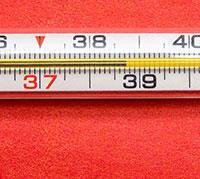
Fever is not a disease, but rather a symptom and indication of the presence of inflammation in the body. Fever may be a primary expression of dozens of diseases of varying degrees of severity and severity. Usually in most cases it is mild and goes away on its own. The normal normal body temperature ranges between 36-38 degrees Celsius, and the body temperature varies according to the age of the person and depending on the location where the temperature is measured. In adults, the body temperature is usually lower by about half a degree Celsius compared to children and youth. Body temperature measured in the mouth is about half a degree Celsius lower than that measured from the anus, so every value above 37.5°C should be considered a rise in body temperature.
Fever symptoms
Among the most prominent symptoms of feeling a fever are the following
1. General symptoms of fever
One of the most prominent symptoms of a fever is the feeling of the following
Shivering and feeling cold.
sweating
Anorexia.
dehydration
Increased sensitivity to pain.
Loss of energy and drowsiness.
Difficulty concentrating.
2. Symptoms of fever in children
Among the most prominent signs of high temperature in children are the following
Feeling hot when touching a child.
redness of the cheeks
sweating
irritation.
confusion.
epileptic seizures
3. Symptoms that require a visit to the doctor when the temperature rises
In the following cases, it is preferable to go to the doctor
A condition in which the high temperature persists for more than three days.
Infants up to two months of age when there is any rise in temperature.
Fever accompanied by the following phenomena
severe headache
Nausea.
vomiting.
drowsiness.
A change in the cognitive state.
Soreness when swallowing.
Burning while urinating.
Rash spreading on the skin or blisters.
Convulsions.
Patient age over 75 years and over.
Patients with heart disease, diabetes, or known chronic lung disease.
Causes and risk factors for fever
There are many causes and factors that lead to a rise in temperature, which are as follows
1. Causes of overheating
Normal body temperature is determined by the thermostat located in the brain. Among the most prominent causes of fever are the following:
inflammation
When there is inflammation in the body, leukocytes secrete chemicals, such as: cytokines, or interleukins. These substances cause a disturbance in the functioning of the thermostat, which leads to an increase in muscle activity to the point of tremor and a rise in temperature. the body.
In addition, in cases where the temperature of the surrounding environment is very high, the body temperature also rises as a result of the absorption of external heat.
catch infection
The main cause of high body temperature is infection viral, or bacterial infection.
The main feature that distinguishes a bacterial disease is a sudden rise in temperature and a tendency to shiver, unlike a viral disease in which the temperature rises gradually and for a longer period.
some types of diseases
Other diseases that cause a high body temperature include
Inflammatory diseases, such as: rheumatic diseases.
Diseases that affect the immune system and antibody production, such as lupus erythematosus (SLE).
Less common diseases, such as: neoplastic diseases that affect the liver, lymphoid system, or significant damage to the brain.
some medicine
In some cases, a high temperature can occur due to the consumption of some medications, including antibiotics. In most cases, fever alone is not the only sign, and physical signs and additional laboratory tests must be sought to reach the correct diagnosis.
2. Risk factors
As mentioned, a slight increase in body temperature does not cause harm to healthy people, but there are some groups who are at risk and they are as follows:
babies.
elderly.
Patients who suffer from chronic diseases, such as: heart disease, diabetes, and lung disease.
Fever complications
The most prominent complications of high temperature occur in infants, which are often epileptic seizures.
Fever diagnosis
The temperature should be measured with a thermometer in the mouth, armpit, ear, or anus, and the measurement should be accurate and objective without relying on the impression generated by placing the hand on the forehead, or simply the sensation that the temperature is high.
Where the doctor can diagnose a fever by checking the person''s body temperature with a thermometer, but he will also need to diagnose the cause of the fever, and this is done through:
1. Taking a medical history
To do this, the doctor will examine the patient and ask him about any other symptoms and his medical history, and if the person has recently been exposed to an infection, or if he has undergone surgery recently, or if there is pain or swelling in an area, this may help to determine the type of germ that is likely to be present.
2. Laboratory tests
To confirm the diagnosis, the doctor may recommend
blood test
urine test
Imaging tests.
Fever treatment
High temperature is treated as follows
1. Treatment of hyperthermia
A mild rise in body temperature in children is less than 39 degrees Celsius and is often accompanied by a viral disease that fades away spontaneously within a certain period of time and does not require any treatment. Such a disease is often accompanied by a mild cough, muscle pain, sore throat, and a catarrh. ), and a general feeling of weakness.
In such cases, there is no need to treat the fever, and often a high body temperature may be beneficial, as it may help to cope with the disease in a more successful and better way.