
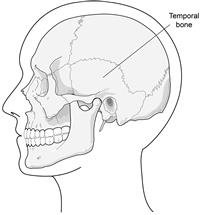
The temporal bone (the skull bone containing part of the ear canal, the middle ear, and the inner ear) can be fractured, usually by a blow to the head.
A temporal bone fracture may cause facial paralysis, hearing loss, bruising behind the ear, and bleeding from the ear.
Doctors use computed tomography (CT) to diagnose temporal bone fractures.
Treatment, sometimes including surgery, is needed if the fracture causes problems.
Temporal bone fractures can cause various injuries to the middle and inner ear. Injuries include rupture of the eardrum and damage to the ossicles (the chain of small bones that connects the eardrum to the inner ear), the cochlea (the organ of hearing), the vestibular apparatus (the organ of balance in the inner ear), or the nerve that controls muscles of the face (facial nerve).
Symptoms of Temporal Bone Fracture
People have pain and often
Bleeding from the ear
Bleeding behind the eardrum
Bruising of the skin behind the ear
Other symptoms and complications vary depending on the exact location of the fracture.
Some people have facial paralysis on the side of the fracture. Facial paralysis can develop immediately or after some time and can be mild or severe.
Another symptom is severe hearing loss. Hearing loss may result from damage to the three tiny bones (called the ossicles) that connect the eardrum to the inner ear or from damage to the cochlea or the nerve that leads to the cochlea.
If the vestibular apparatus is damaged, people may feel as if they or their surroundings are spinning (vertigo) or have problems with balance.
Sometimes, fluid from around the brain and spinal cord (cerebrospinal fluid) leaks from the brain through the fracture and appears as clear fluid draining from the ear or nose. Leakage of this fluid indicates that the brain is exposed to possibly serious infection from bacteria in the ear canal.