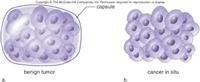

Many concerns may arise when a mass appears in the breast, especially when pregnant and breastfeeding, so what is the relationship between benign breast tumors and breastfeeding?
Details about benign breast tumors and lactation in the following lines
Benign breast tumors and lactation
When you feel a lump in the breast during pregnancy or breastfeeding, you should go to the doctor to check the seriousness of this lump, which can be a benign tumor or a malignant tumor that must be removed. A benign tumor is an abnormal growth in the breast tissue and is more common than breast cancer.
It is diagnosed by conducting some radiological images and necessary laboratory tests. This is because benign tumors are less dangerous and treatable if caught early.
Types of benign breast tumors in infancy
There are some types of benign breast tumors that appear during the lactation period. Here are the most important of them:
Benign breast tumors during lactation are the most common
There are many types of benign breast tumors during the lactation stage, and here are the most prominent of them:
1. Lactating Adenoma
Breast adenoma is the most common type of benign breast tumor during lactation.
The benign tumor usually consists of fibrous glandular tissue that can occur due to hormonal changes related to lactation that cause hyperplasia of the fibrous glandular connective tissue in the breast, which leads to a lack of blood supply to the tissue, and this type of benign breast tumor and lactation usually has the form of irregular masses .
These benign tumors often disappear on their own, but sometimes the doctor may prescribe some medications for you, such as: Bromocriptine, which may help reduce the size of the tumor and reduce milk production.
2. Milk sacs (Galactoceles)
Milk cysts may result due to obstruction of the milk duct during lactation, which may cause the appearance of a milky mass. This type of benign tumor is usually soft to the touch.
It can usually be treated by draining the lumpy milk sacs. Applying cool compresses to the area and wearing a comfortable bra may also help relieve symptoms.
3. Mastitis
Cracks resulting from breastfeeding may cause some bacteria to enter the breast, leading to mastitis, which includes the following symptoms:
Pain and redness in the breast.
High body temperature and headache.
White discharge from the nipple.
An abscess in the breast.
The doctor can treat mastitis that may cause benign tumors by taking antibiotics and some pain relievers, such as: acetaminophen and ibuprofen, in addition to warm compresses.
4. Fibrocysts
Among the benign breast tumors during the lactation period are fibrous cysts that may appear during pregnancy, lactation, or even at menopause, and are usually formed as a result of blockage in the breast ducts or irregularity of the substances absorbed and secreted in the breast and may cause recurrent pain in the breast or may form a lump inside it.
5. Fibroadenoma
One of the most common breast-feeding benign tumors is the fibroadenoma. It is often due to hormonal changes, which may cause abnormal growth in the breast tissue, and thus the appearance of a visible lump in it.
Benign breast tumors during lactation are the least common
Here are the most common types of benign breast tumors during lactation
Intraductal papilloma.
Pseudoangiomatous stromal hyperplasia.
Juvenile papillomatosis.
Methods of prevention of benign breast tumors through breastfeeding
Doctors recommend breastfeeding because it benefits the health of both the mother and the child. The following is an explanation of its benefits:
It reduces the mother''s risk of breast cancer, due to the fact that breastfeeding regulates hormones.
Breastfeeding may help get rid of damaged or damaged breast tissue and abnormal cells, which may reduce the chances of developing breast cancer, and the longer the duration of breastfeeding, the lower the risk of developing breast cancer by 4.3%.
Breastfeeding reduces the chances of developing cancer for your child as well, as breastfeeding can reduce the risk of a child gaining weight that may cause several types of cancer, such as: pancreatic cancer and rectal cancer.