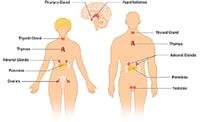

are located?
The human body contains a set of endocrine glands, but where are the endocrine glands located? Here is the most important information about the whereabouts of the endocrine glands in this article.
The endocrine system consists of a group of glands responsible for secreting hormones that regulate the communication of cells and organs of the body with each other, so where are the endocrine glands? What are its main functions?
Where are the endocrine glands located?
As mentioned, the body contains a large group of endocrine glands distributed in its various parts. Where are the endocrine glands located? Its most prominent functions are as follows:
1. Hypothalamus gland
The hypothalamus is a small gland consisting of nerve fibers and bodies located under the hypothalamus in the brain.
2. Pituitary gland
The pituitary gland is a small, oval-shaped gland located behind the nose in the lower region of the brain, specifically in the hollow region of the sphenoid bone inside the skull, with a diameter of 1.25 centimeters.
3. The pineal gland
Include the answer to the question where are the endocrine glands? The pineal gland, which is a gland located in the brain also in the middle between the two parts of the brain, is named by this name because of its shape that resembles a pine, and its length is 0.8 centimeters, and its weight is approximately 0.1 grams.
4. Thyroid gland
The thyroid gland is located in the anterior region of the neck, just below the laryngeal protrusion, or the so-called Adam''s apple. Its shape resembles a butterfly, as it consists of two cotyledons connected by an isthmus.
5. Parathyroid glands
Completing the answer to where are the endocrine glands? The parathyroid glands are small glands about the size of a grain of rice, four in number, located just behind the thyroid gland.
6. Adrenal glands
The body contains two adrenal glands located above the kidney. The adrenal gland on the right side differs slightly in shape and height above the kidney compared to the left.
7. The pancreas
The pancreas, in addition to being an endocrine gland, is also part of the digestive system. The pancreas is located in the upper abdomen, just behind the stomach.
8. Gonads
The gonads are represented by the ovaries in females and the testicles in males, as the woman’s body contains two ovaries, each of which is located on one side of the uterus and connects with it to the fallopian tube.
As for the testicles, the man''s body contains two oval-shaped testicles, each of which encloses a sack called the scrotum. The size of the testicle is approximately 20 cubic centimeters in youth, and their size decreases with age.
The length of one testicle ranges from approximately 4.5 to 5.1 centimeters.
Endocrine functions
After you know where the endocrine glands are located? Here are its most important functions:
1. The function of the hypothalamic gland
The hypothalamus is one of the most important glands because it is responsible for the following functions:
Regulate the work of other glands.
Forming a link between the endocrine system and the nervous system, because its primary function is to maintain balance in the body.
Regulating body temperature.
Control of emotions and feelings.
Regulating food digestion, appetite and thirst.
2. Pituitary gland function
The pituitary gland is divided into two parts, the anterior pituitary gland and the posterior pituitary gland.
The pituitary gland is connected to the hypothalamus gland and they work together in regulating the work of other endocrine glands. The pituitary gland also has a wide range of functions and secretes many hormones.
The functions of the pituitary gland mainly include the following
regulate the growth process.
Activating the work of the adrenal glands, thyroid gland and reproductive glands.
Stimulating the secretion of milk in the breast.
Maintaining the balance of water and sodium salts in the body.
Organizing the birth process.
3. The function of the pineal gland
The pineal gland is formed from a group of neurons and pineal cells responsible for the secretion of hormones.
In fact, the basic function of the pineal gland is not yet known, but according to what has appeared recently, it has an important role in regulating the body''s biological clock, which is the sleep-wake cycle due to its secretion of the hormone melatonin.
4. Thyroid function
The thyroid gland has an essential function, which is to regulate the body''s metabolic processes, so that it controls the following:
glucose manufacture.
Glucagon breakdown.
Manufacture of proteins.
Fat breakdown.
temperature regulation.
5. The function of the parathyroid glands
The primary function of the parathyroid glands is to regulate the levels of calcium and phosphorus between the blood and the bones.
6. Adrenal function
The adrenal gland is divided into 3 sections, two of which are responsible for the secretion of hormones, one of which is called the adrenal cortex, which is responsible for regulating the levels of water and sodium salts in the body, raising blood sugar levels when needed and many other functions.
The other section is the adrenal medulla, which is responsible for the secretion of hormones responsible for the fight-or-flight process, reaction and response to external stimuli.
7. Pancreatic function
The pancreas is divided into three parts: the head of the pancreas, the body of the pancreas, and the tail of the pancreas.
The basic functions of the pancreas include the following
Secretion of hormones that help in the process of digesting food from proteins, fats and sugars.
Secretion of insulin, which is responsible for regulating the level of glucose in the blood.
8. Gonadal function
The primary function of the ovaries is to produce, store and release eggs by secreting the female hormones estrogen and progesterone.
The primary function of the testicles is to secrete testosterone and androgens and to store and produce sperm.