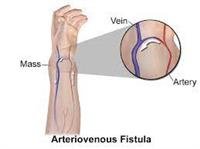
An arteriovenous fistula is an abnormal channel between an artery and a vein.
Rarely, a large fistula may divert enough blood to cause symptoms of reduced blood flow in the affected arm or leg (steal syndrome).
Although doctors may be able to hear the distinctive sound of blood flow though a fistula by using a stethoscope, imaging tests are often needed.
Fistulas can be cut out or eliminated with laser therapy, or sometimes substances are injected into the fistula to block the blood flow.
Arteries carry blood with oxygen and nutrients away from the heart to the rest of the body. Veins return blood to the heart from the rest of the body. Capillaries are tiny, extremely thin-walled vessels that act as a bridge between arteries and veins. The thin walls of the capillaries allow oxygen and nutrients to pass from the blood into tissues and allow waste products to pass from tissues into the blood.
Normally, blood flows from arteries into capillaries and then into veins. An arteriovenous fistula is an abnormal connection directly between an artery and a vein. With an arteriovenous fistula, some blood flows directly from an artery into a vein, bypassing the capillaries.
Arteriovenous fistulas may be
Congenital, meaning the person was born with one
Acquired, meaning that it developed (or was d) after birth
Arteriovenous Fistula
Arteriovenous Fistula
Congenital arteriovenous fistulas are uncommon.
Acquired arteriovenous fistulas can be caused by any injury that damages an artery and a vein that lie side by side. Typically, the injury is a piercing wound, as from a knife or bullet. The fistula may appear immediately or may develop after a few hours. The area can swell quickly if blood escapes into the surrounding tissues.
Blood Vessels
VIDEO
Intentional creation of arteriovenous fistulas for medical treatment
Some medical treatments, such as kidney dialysis, require that a vein be pierced for each treatment. With repeated piercing, the vein becomes inflamed and clotting can develop. Eventually, scar tissue may develop and destroy the vein. To avoid this problem, doctors may deliberately an arteriovenous fistula, usually between an adjoining vein and artery in the arm. This surgical procedure widens the vein, making needle ion easier and enabling the blood to flow faster. Faster flowing blood is less likely to clot. Unlike some large arteriovenous fistulas, these small, intentionally d fistulas do not lead to heart problems, and they can be closed when no longer needed.