
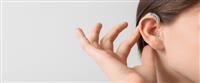
The auditory nerve transmits sound waves to the brain so that speech is understood. What are the methods used to treat auditory nerve weakness?
Each case differs from the other in the way it treats auditory nerve dysfunction, but the audiologist may have to try all available solutions before deciding on the best solution for the patient. We present to you methods for treating auditory nerve dysfunction in the following lines:
Treatment of auditory nerve dysfunction: frequency modulation systems
They are wireless hearing devices that amplify the sound from its source and transmit it to the individual while reducing background sounds and focusing on the sound to be heard by using radio waves that modify the frequency and transmit the sound while maintaining the clarity and quality of the transmitted sound.
The frequency modulation system consists of two main devices: a transmitter and a receiver. The transmitter receives sound from its source and transmits it to the receiver.
Although frequency modulation systems are flexible and easy to navigate, induction systems or acoustic induction loops, which are used to send and receive communication signals, may not be available in most public places, so a person may have difficulty communicating with others.
Treatment of auditory nerve dysfunction: hearing devices
Hearing aids are one of the most important hearing devices used in treating auditory nerve dysfunction.
My Player placeholder
Hearing aids transmit sounds from the external environment to the ear, as most hearing aids are digital, meaning they contain a chip equipped with a speaker.
The chip converts the sound from sound waves into a digital code, then adjusts the sound based on the hearing loss for each case. The modified digital code is then converted into sound waves that reach the ears through the speakers. Hearing aids also contain batteries that are changed periodically or are removable batteries. To recharge.
There are types of hearing aids to treat auditory nerve dysfunction, the most prominent of which are:
1. CIC-Completely In the Canal Hearing Aids
This type of hearing aid improves mild to moderate hearing in adults. It is completely within the auditory canal in the ear. It is the smallest and least visible type. It also uses batteries that have a relatively short life and is prone to clogging with earwax.
2. In-the-Canal Hearing Aids (ITC-In The Canal)
It is partially inside the ear canal and may improve mild to moderate hearing performance in adults.
This type is less visible than larger hearing aids, is more difficult to adjust due to its small size, and is prone to clogging with earwax.
3. ITE-In The Ear Hearing Aids
It is used for people who suffer from mild to severe hearing loss. This type also features a microphone that improves sound quality in noise, meaning it is clearer than small devices, in addition to a long battery life that may be rechargeable.
4. BTE-Behind The Ear
It is installed behind the ear and this type is suitable for all ages and for all causes of hearing loss.
It is used to treat hearing loss because it is able to amplify almost all sounds. It also contains directional microphones and may be available with a rechargeable battery.
Treatment of auditory nerve dysfunction: surgery
Auditory nerve weakness can be treated through a cochlear implant, which is the last solution that a specialist audiologist resorts to after trying earphones. It also does not treat hearing loss, but it prevents the hearing loss from getting worse.
The cochlear implant is a complex electronic device that may help amplify sound for those who suffer from hearing loss. The cochlear implant consists of the following parts:
An external part located behind the ear.
An internal part that is surgically placed inside the ear.
A microphone picks up sounds from the external environment.
A processor of the sounds that a microphone picks up and arranges.
A transceiver that receives signals from the processor and converts them into electrical impulses.
A group of electrodes that collect electrical impulses and send them to the auditory nerve.
Stimulators or stimulants of the auditory nerve.
Cochlear implantation may be used to treat auditory nerve weakness or hearing loss, as it amplifies sounds by stimulating the auditory nerve, which in turn transmits the sounds produced and sends them in the form of signals to the brain, which recognizes the sent signals as intelligible sounds.
However, it may take people a varying amount of time to learn or relearn speech.