it measured?
What is the rate of osteoporosis? What are the ways to measure it? Who are the target groups for osteoporosis screening? Find out the answer below:
Osteoporosis is a static disease in which the bone loses calcium and necessary minerals, its density decreases, and it becomes vulnerable to fracture without obvious symptoms.
This makes the bone density (BMD) test of great importance for detecting osteoporosis and predicting the risk of future fractures, as it is a test that measures the rate of osteoporosis.
Let us learn together about this examination and its relationship to the rate of osteoporosis as follows:
What is the rate of osteoporosis?
It is the percentage in which bone density is less than a certain value that indicates osteoporosis.
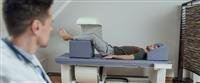
The rate of osteoporosis is measured through a bone density test, in which the amount of minerals, such as: calcium and phosphorus, inside the bones is measured with the help of X-rays.
My Player placeholder
How is the rate of osteoporosis determined?
The results of the bone density examination are read and the results are analyzed by a radiologist. This examination results in specific values indicated by a “T” and a “Z” sign.
1. The meaning of the sign T
The T score represents the standard deviation of bone density compared to the bone density of healthy young adults of the same sex.
The following table shows the normal ratios for this sign and the ratios that indicate the occurrence of osteoporosis:
T-score results
Meaning of the result
-1 or higher
Your bone density is normal
Between -1 and -2.5
You are at risk of developing osteoporosis. Your bone density is lower than normal
-2.5 and below
Your bone density is so low that you probably have osteoporosis
2. The meaning of the Z sign
Your bone density is compared to the bone density of peers of the same age, gender and size.
If the Z-score is less than -2, this means that your bone density is lower than that of your peers of the same age, which indicates that there could be reasons other than aging.
Which groups are advised to undergo a bone density examination?
The following groups are most at risk of developing osteoporosis, and therefore they must undergo a bone density examination and find out their percentage of osteoporosis:
People who have had a broken bone after the age of 50.
Postmenopausal women who suffer from certain risk factors that increase your chance of developing osteoporosis.
Postmenopausal women over the age of 65 years.
Women whose menstrual cycle has stopped or become irregular without pregnancy or menopause.
People who suffer from back pain without any apparent cause.
People who have undergone an organ transplant.
People who have experienced a in hormone levels in the body.
People who have noticed an increase in the curvature and curvature of your back.
Men age 70 and older.
People who have had a spine X-ray that shows fractures or bone loss in the spine.
People with back pain with a possible fracture.
People who have noticed a height loss of 1.5 cm or more within one year.
People who notice a loss of 1.5 cm from their original height.