Important
It is possible that the main title of the report Rubella is not the name you expected. Please check the synonyms listing to find the nate name(s) and disorder subdivision(s) covered by this report.
Synonyms
German Measles
Three-Day Measles
Disorder Subdivisions
None
General Discussion
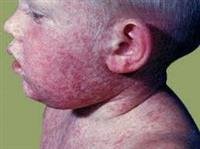
Rubella is a viral infection characterized by fever, headache, swollen lymph nodes, aching joints, and a distinctive red rash. Although it is sometimes called German measles or three-day measles, it is not caused by the same virus that causes measles. Rubella is generally mild in children and more severe but not life-threatening in adults. However, if a pregnant woman is infected with rubella, it can cause serious problems for the unborn child. In the United States, most children receive the measles-mumps-rubella (MMR) vaccine, and therefore the disease has become uncommon. In March 2005, health officials announced that rubella has been eliminated from the United States. However, it is still important for Americans to vaccinate their children, and women who are pregnant or might get pregnant still need to be sure they are immune, because the disease exists elsewhere. According to the Centers for Disease Control and Prevention (CDC), nine rubella cases were reported in the United States in 2004, and all of them originated in other countries.