The disease where the abnormal formation of heart structure occurs during the birth is congenital heart disease. It is a disorder of heart or central blood vessels that is present at birth. It is also known as a congenital heart anomaly or congenital heart defects. It is a problem with the structure of the heart. The defects can involve the walls of the heart the valves of the heart and the arteries and veins near the heart. They can disrupt the normal flow of blood through the heart. The blood flow can slow down go in the wrong direction or to the wrong place or be blocked completely. It includes breathlessness failure to attain normal growth. This disease is the leading cause of the death. Most children with congenital heart disease are treated with surgery. It is the most common type of birth defect. They affect 8 out of every 1,000 newborns. Each year more than 35,000 babies are born with congenital heart defects. About 6 to 19 per 1,000 cause a moderate to severe degree of problems. Congenital heart defects are the leading cause of birth defect-related deaths.
Congenital Heart Disease Types
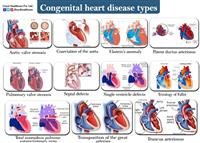
Aortic valve stenosis : Aortic valve stenosis is uncommon and serious type of congenital heart defect. It accounts for around 5% of cases of congenital heart disease. In aortic valve stenosis the aortic valve that controls the flow of blood out of the main pumping chamber of the heart to the body main artery is narrowed. This affects the flow of oxygen rich blood away from the heart towards the rest of the body and may result in the left ventricle muscle thickening because the pump has to work harder.
Coarctation of the aorta : Coarctation of the aorta is where the main artery has a narrowing which means that less blood can flow through it. It accounts for around 10% of cases of congenital heart disease. It can occur by itself or in combination with other types of heart defects most commonly a ventricular septal defect or patent ductus arteriosus. In around half of all cases the narrowing can be severe and will require treatment shortly after birth.
Ebstein’s anomaly : Ebstein’s anomaly is where the valve on the right side of the heart separates the right atrium and right ventricle and does not develop properly. This means blood can flows in the wrong way within the heart and the right ventricle may be smaller and less effective than normal. It can occur on its own but it often occurs with atrial septal defect. It accounts for less than 1% of congenital heart disease cases.
Patent ductus arteriosus : Patent ductus arteriosus is a rare type of congenital heart disease affecting around 5 in every 100,000 babies. As a baby develops in the womb a blood vessel called the ductus arteriosus connects the pulmonary artery directly to the aorta. The ductus arteriosus diverts blood away from the lung to the aorta. A patent ductus arteriosus is where this connection does not close after birth as it is supposed to. This means that extra blood is pumped into the lungs forcing the heart and lungs to work harder.
Pulmonary valve stenosis : Pulmonary valve stenosis is a defect where the pulmonary valve which controls the flow of blood out of the right heart pumping chamber to the lungs is narrower than normal. This means the right heart pump has to work harder to push blood through the narrowed valve to get to the lungs. Pulmonary valve stenosis accounts for around 10% of cases of congenital heart disease.
Septal defects : A septal defect is where there’s an abnormality in the wall (septum) between the main chambers of the heart. The two main types of septal defect like atrial septal defects, it is where there is a hole between the two collecting chambers of the heart. ventricular septal defects, it occurs when there is a hole between the 2 pumping chambers of the heart.
Single ventricle defects : A single ventricle defect is where only one of the pumping chambers develops properly. Without treatment, these defects can be fatal within a few weeks of birth. Two of the more common single ventricle defects are hypoplastic left heart syndrome, it is a rare type of congenital heart disease, where the left side of the heart does not develop properly and is too small. tricuspid atresia, it is where the tricuspid heart valve has not formed properly.
Tetralogy of Fallot : Tetralogy of Fallot is a combination of several defects, affecting about 3 in every 10,000 babies. The defects making up tetralogy of Fallot are: ventricular septal defect – a hole between the left and right ventricle. pulmonary stenosis – narrowing of the pulmonary valve. right ventricular hypertrophy – where the muscle of the right ventricle is thickened. displaced aorta – where the aorta isn’t in its usual position coming out of the heart.
Total anomalous pulmonary venous connection (TAPVC) : TAPVC occurs when the four veins that take oxygenated blood from the lungs to the left side of the heart are not connected in the normal way. Instead they connect to the right side of the heart. Sometimes only some of the four veins are connected abnormally which is known as partial anomalous pulmonary venous connection and may be associated with an atrial septal defect. TAPVC is an uncommon type of congenital heart disease, affecting around 7 in every 100,000 babies.
Transposition of the great arteries : Transposition of the great arteries is relatively common accounting for around 5% of cases of congenital heart disease. It is where the pulmonary artery and main body artery are swapped over and are connected to the wrong pumping chamber. This leads to blood that is low in oxygen being pumped around the body.
Truncus arteriosus : Truncus arteriosus is an uncommon type of congenital heart disease affecting around 5 in every 100,000 babies. It is where the two main arteries do not develop properly and remain as a single vessel. This results in too much blood flowing to the lungs which over time can cause breathing difficulties and damage the blood vessels inside the lungs.
congenital heart disease types.
Congenital Heart Disease Causes
Genes : Several genetic health conditions a baby inherits from one or both parents can cause congenital heart disease. Down’s syndrome is the most widely known genetic condition that can cause congenital heart disease. Children with Downs syndrome are born with a range of disabilities as the result of a genetic abnormality. About half of all children with down’s syndrome have congenital heart disease. Other genetic conditions associated with congenital heart disease include turner syndrome, it is a genetic disorder that only affects females it is estimated that 25% of children with turner syndrome. Noonan syndrome, it is a genetic disorder that can cause a wide range of potential symptoms around 80% of children with noonan syndrome.
Diabetes : Women with diabetes are five times more likely to give birth to a baby with congenital heart diseasethan women who do not have diabetes. It is estimated that 3-6% of women with diabetes who become pregnant will give birth to a baby with a heart defect most commonly, transposition of the great arteries. This increased risk only applies to type 1 diabetes and type 2 diabetes. It does not apply to gestational diabetes, which can develop during pregnancy and usually disappears once the baby is born.
Alcohol consumption : If a pregnant woman drinks too much alcohol during pregnancy, it can have a poisonous effect on the tissue of the foetus. This is known as foetal alcohol syndrome. It is estimated that as many as half of all children with foetal alcohol syndrome will have congenital heart disease most commonly, ventricular or atrial septal defects.
Rubella : Rubella also known as german measles is an infectious condition caused by a virus. It is not usually a serious infection for adults or children but it can have a devastating effect on an unborn baby if a mother develops a rubella infection during the first 8 to 10 weeks of pregnancy. A rubella infection can cause multiple birth defects including congenital heart disease.
Flu : Women who get flu during the first three months of pregnancy are twice as likely to give birth to a baby with congenital heart disease than the general population. The reasons for this are unclear. The flu vaccine is recommended for all pregnant women.
Medications :There are several medications linked to an increased risk of a baby being born with congenital heart disease. These include:
Anti-seizure medications – Benzodiazepines and lithium.
Acne medications –Isotretinoin and topical retinoids.
Ibuprofen – Women who take the painkiller ibuprofen during the first trimester of their pregnancy are twice as likely to give birth to a baby with congenital heart disease.
Organic solvents : Women who are exposed to organic solvents are three times more likely to give birth to a baby with congenital heart disease than the general population. Organic solvents are chemicals found in a wide range of products and substances such as paint, nail polish and glue.
Congenital heart disease causes.
Congenital Heart Disease Symptoms
Excessive sweating.
Extreme tiredness.
Rapid heartbeat.
Rapid breathing.
Shortness of breath.
Chest pain.
Clubbed fingernail.
Congenital heart disease symptoms.
Congenital Heart Disease Tests
Echocardiography – It is often used to check the inside of the heart. Heart problems that were missed during foetal echocardiography can sometimes be detected as a child develops.
Electrocardiogram – An electrocardiogram (ECG) is a test that measures the hearts electrical activity. Electrodes are placed on the skin around the heart and are connected to a computer. The computer analyses the electrical signals produced by the heart to assess how well it is beating.
Chest X-ray – A chest X-ray of the heart and lungs can be used to check whether there is an excess amount of blood in the lungs or whether the heart is larger than normal. Both may be signs of heart disease.
Pulse oximetry – Pulse oximetry is a test that measures the amount of oxygen present in the blood. The test involves placing a special sensor on the fingertip, ear or toe that sends out light waves. A computer is connected to the sensor and measures how the light waves are absorbed. Oxygen can affect how the light waves are absorbed, so by analysing the results, the computer can quickly determine how much oxygen is present in the blood.
Cardiac catheterisation – Cardiac catheterisation is a useful way of obtaining more information about exactly how the blood is being pumped through the heart. During the procedure a small, flexible tube called a catheter is ed into a blood vessel usually through an artery or vein in the arm. The catheter is moved up into the heart guided by X-rays or sometimes an MRI scanner and allows pressure measurements in different parts of the heart or lungs to be taken. A coloured dye that shows up on X-rays can also be injected into the catheter. The dye can be studied as it moves through the heart allowing the shape and function of each heart chamber vessels and the lung to be assessed. Cardiac catheterisation is painless because it is carried out under a general anaesthetic.
Congenital heart disease tests.
Congenital Heart Disease Treatment
Medications – Some mild congenital heart defects can be treated with medications that help the heart work more efficiently. These are also need to take medications to prevent blood clots from forming or to help control an irregular heartbeat.
Implantable heart devices – Devices that help to control heart rate or that correct life threatening irregular heartbeats can help some of the complications associated with congenital heart defects.
Special procedures using catheters – Some congenital heart defects can be repaired using catheterization techniques which allow the repair to be done without surgically opening the chest and heart. In procedures that can be done using catheterization the doctor s a thin tube called catheter into a leg vein and guides it to the heart with the help of X-ray images. Once the catheter is positioned at the site of the defect, tiny tools are threaded through the catheter to the heart to repair the defect.
Open-heart surgery – If catheter procedures are not enough to fix heart defect doctor recommends openheart surgery.
Heart transplant – If a serious heart defect can not be repaired a heart transplant will be an option.
Congenital heart disease treatment
Congenital Heart Disease Prevention
Get vaccinated against rubella and flu.
Avoid drinking alcohol and taking drugs.
Avoid contact with people who are known to have an infection.
If you have diabetes, make sure it is controlled.
Avoid exposure to organic solvents such as those used in dry cleaning, paint thinners and nail polish remover.