While there's no cure for chronic obstructive pulmonary disease (COPD), inhaled medication can help. Along with other treatments, inhaled drugs for COPD can improve symptoms and a person's quality of life.
There are two main ways inhaled medicine is used. The first is with an inhaler, and the second is with a nebulizer. Here's what you need to know about the differences.
COPD Treatment: Inhalers and Nebulizers
Inhalers and nebulizers have the same purpose: to get the drugs into the lungs where you need them. Both deliver the same types of medicine, and both are equally effective when used properly.
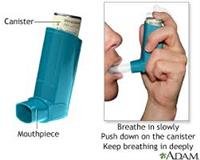
Inhalers are small, handheld devices that deliver a puff of medicine into the airways. There are three basic types: metered-dose inhalers (MDIs). dry powder inhalers (DPIs), and soft mist inhalers (SMI).
MDIs contain a liquid medication that is delivered as an aerosol spray. The medicine is held in a pressurized cannister that has a metering valve. You can close your lips around the mouthpiece or place the mouthpiece 1 to 2 inches from your mouth and breathe in slowly as you press down on the inhaler. An native method that many find preferable is to use a spacer. A spacer is a hollow plastic tube used between the mouthpiece and the canister of medicine. A spacer makes it easier to get the full dose of medication all the way to your lungs.
A DPI is similar, but it releases a puff of dry powder instead of a liquid mist. DPIs should not be used with a spacer. Instead, close your mouth tightly around the mouthpiece of the DPI inhaler and inhale rapidly and steadily. It is important to remove the device from your mouth before exhaling so that humid air doesn’t get into the device and cause the powder to clump.
An SMI is a newer type of inhaler that provides a pre-measured amount of medicine in a slow-moving mist that helps you inhale the medicine. You put your lips on the mouthpiece while holding the device horizontally and being careful not to cover the air vents. It actively delivers medicine in a way that does not depend on how fast you breathe the air from the inhaler in.
While inhalers use the same general principle, don't assume that they all work the same way. For instance, while you're supposed to shake an MDI before using it, you should never shake a DPI. Each device needs to be cleaned differently and has a different way of tracking when it’s empty. Always follow the instructions for the specific device.
Nebulizers are machines that convert a liquid medicine into a mist that you inhale into your lungs. Nebulizers aren't particularly portable, so you keep a nebulizer at home. To use it, you measure out the medicine into a cup and attach the cup with tubing to the machine. Then you turn it on, relax, and breathe the mist in deeply through a mouthpiece or mask. Depending on the medication, it usually takes 20 minutes or less to inhale the medicine. Afterwards, you need to clean the nebulizer and mouthpiece or mask with water and, periodically, soap before you use it again.
Inhalers and nebulizers are only available by prescription. While you might see some bronchodilator inhalers sold over-the-counter, don't use them unless your doctor recommends it. They could be dangerous for people with certain health conditions, such as heart problems.
COPD Treatment: Which Is Better for Me?
Which approach is better: a nebulizer or an inhaler? It depends on what your doctor recommends, your personal preference, and what insurance will cover. The key is making sure you feel comfortable using whichever one you choose correctly.
Most people with COPD use inhalers. One big advantage is that they're portable. While you have to use a nebulizer at home (or in a medical facility) you can carry an inhaler in your pocket. Inhalers also deliver medication more quickly. After a few puffs, perhaps separated by a minute or two, you're done.
However, using inhalers correctly can take some practice. Numerous studies have found that fewer than half the people with MDIs for asthma or COPD actually use them properly.
For people who have trouble with inhalers, nebulizers can be the best choice. They also can be temporarily helpful for COPD flare-ups. Some people just prefer nebulizers and feel that they're more effective. Your doctor will have advice about which approach makes sense in your case.
Because nebulizers are expensive and require maintenance, insurance companies might be less likely to cover them for long-term use.
5 Tips for Using Inhaled COPD Medicine
Know how to use it. If you're not using inhaled medicine correctly, it won't help you. When you first get the prescription, go over the instructions with a health care provider or pharmacist -- or if you have a nebulizer, with a representative from the medical supply company. After that, check in occasionally to make sure that you're still using it properly.
Know when to use it. If you are prescribed a nebulizer or inhaler, make sure you understand when to use it. Is it only for times when you have a COPD flare-up? Or do you need it every day?
Know how much you need. Always follow the prescription exactly -- never take more or less than your doctor recommends. If you're having a COPD flare-up and your normal dosage hasn't helped, don't keep taking more. Instead, get medical help right away.
Know what the drug does. You might need more than one kind of inhaled medication. The most common treatment for COPD is a bronchodilator, which relaxes the muscles around the airways, allowing them to open up. There are many types of bronchodilators, such as anticholinergics and beta2-agonists. Some people with COPD need treatment with inhaled corticosteroids, which can reduce swelling in the air passages. Some of these medications are short-acting, others are long-acting, and some kick in quickly while others take time to work.
Keep track of your medication. Since controlling COPD is so important, make sure you always know how much medicine you have left. Get refills on time. You never want to run out unexpectedly. And if you're taking multiple prescriptions, be careful not to confuse them.