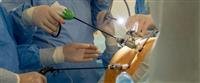

What is Laparoscopic surgery?
laparoscopic-surgery2Laparoscopic surgery is also called minimally invasive surgery (MIS), bandaid surgery and keyhole surgery. It is a specialized surgical technique in which operations in the abdomen are performed through small incisions or ports usually 0.5–1.5 cm. A large single incision is carried out in traditional open surgery procedures. Keyhole surgery uses images displayed on TV monitors for magnification of the surgical elements. Laparoscopic surgery can also be used for operations within the abdominal or pelvic cavities. Keyhole surgeries performed on the thoracic or chest cavity are called thoracoscopic surgery. Laparoscopic surgeries are popularly performed for Crohn’s disease, ulcerative colitis, rectal prolapse, cancer, diverticulitis and chronic constipation.
Laparoscopic surgery versus Open surgery
Open Surgery
Laparoscopic surgery
8 – 10 inch single incision
Multiple 1/4 or 1/2 inch incisions
Tedious post-operative recovery
Less post-operative recovery
Long hospital stays
Short hospital stay
More need of narcotics and
medications for recovery
Less need of narcotics and medications
for recovery
Higher amount of wound
complications such as infections
Less amount of wound complications
Excessive bleeding with
blood transfusion
Less bleeding and no blood transfusion
Over-exposure of internal organs and
susceptibility to external contaminants
and infections
Reduced exposure of internal organs to
possible external contaminants thereby
reduced risk of acquiring infections.
The Digital laparoscope
The laparoscope is a long, thin, fiber optic cable like a telescope which illuminates and magnifies the structures inside the abdomen. There are two types of laparoscopes:
Telescopic rod lens system: The telescopic rod lens system is a device which uses a single chip or three chip video camera connected to it.laparoscopic-surgery1
Charge-coupled device: In the digital laparoscope the charge-coupled device is placed at the end of the laparoscope instead of the telescopic rod lens system.
A fiber optic cable system is attached which is connected to a ‘cold’ light source such as halogen or xenon. These are ed through a 5mm or 10mm cannula or trocar to view the operative field. After prepping, the abdomen is insufflated with carbon dioxide gas. This elevates the abdominal wall above the internal organs like a dome creating a working and viewing space. CO2 is used because it is common to the human body and can be absorbed by tissue and removed by the respiratory system. It is also non-flammable, which is important because electrosurgical devices are commonly used in laparoscopic procedures.