

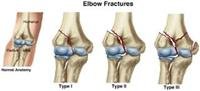
Broken Elbow Overview
Elbow injuries are common in both adults and children. Early recognition and treatment of an elbow injury can reduce the risk of complications and later disability. Any serious injury of the elbow deserves medical attention.
Your elbow is a complex joint formed by 3 bones
The humerus is a single bone in your upper arm that runs from your shoulder to your elbow.
The radius and ulna, bones of your forearm, run from the elbow to the wrist.
Ligaments, muscles, and tendons maintain your elbow's stability and allow joint movement.
A normal elbow joint allows these motions
Flexion, or bending
Extension, or straightening
Rotation, turning your palm up and down
Serious injuries, such as fractures (a bone break) and dislocations, can damage the bones and other structures of your elbow, resulting in problems with movement, blood vessel function, and nerve function. In children, fractures can affect the growth and development of the bones. This is because children have many bone "growth centers," a part of the bone where bone growth takes place. As bone growth continues throughout childhood, if one of these "growth centers" is involved in a fracture, it can affect bone development.
An elbow fracture is a break that involves 1 or more of the 3 arm bones where they work together to form the elbow joint.
Broken Elbow Causes
You can injure your elbow in a variety of ways, from overuse (athletic injuries) to an acute traumatic event (a fall or direct blow). Some common events that result in elbow fractures include:
When you fall backward, off a snowboard for example, you may attempt to brace the fall with your arm outstretched and your hand open.
High-energy trauma can occur in an automobile or motorcycle collision.
A direct blow on the elbow can cause a break when you fall off a skateboard or bicycle and land directly on an elbow.
Sideswipe injury occurs when an elbow is struck while you are resting your elbow out an open car window.
Any other direct injury to the elbow, wrist, hand, or shoulder can affect the elbow.
Broken Elbow Symptoms
If your elbow shows any of the following signs you may have a fracture or another injury that needs medical attention.
Swelling of your elbow or in the area immediately above or below your elbow
Deformity of your elbow, or the areas near your elbow
Discoloration, such as bruising or redness of your elbow
Difficulty moving your elbow through its complete range of motion
Flexion and extension: You should be able to bend your elbow so that you can touch your shoulder with your fingertips. You also should be able to fully straighten your arm.
Inward and outward rotation: When holding your arm at your side with your elbow flexed (bent) at 90°, you should be able to rotate your hand outward so that your palm faces the ceiling. In this same position, you should be able to rotate your hand inward so that your palm faces the floor.
Numbness, decreased sensation, or a cool sensation of your forearm, hand, or fingers
Three major nerves-the median, radial, and ulnar nerves-travel through your elbow. A serious injury may damage these nerves.
Many blood vessels also pass through your elbow. These important vessels may become injured or compressed when trauma or swelling occurs.
A cut, or open wound, on the elbow after a traumatic injury
Severe pain after an elbow injury
A "tight sensation" in the area of your elbow or forearm
When to Seek Medical Care
An elbow fracture carries the risk of potentially serious and disabling complications. If you think your elbow may be fractured, you should seek medical attention at a hospital's emergency department immediately.
Are You Exercising Too Much?
Watch Now
If you have only mild swelling, and no bruising, open wounds, or loss of feeling, you may consider calling a doctor prior to seeking emergency medical attention.
If your elbow shows any of the following problems after an injury to your arm, you should go to an emergency department.
You have swelling at or near the elbow.
You notice any deformity of the elbow or the areas near the elbow.
If you have any doubts, compare your injured elbow to your uninjured one. If you have a new lump or bump, go to the emergency department.
You hear or feel grinding, popping, or clicking as you move your elbow, wrist, or hand.
Your elbow "catches" at the joint.
Your normal elbow motion becomes limited.
You see any discoloration of the elbow or areas near the elbow. A bluish, purplish, or blackish color may mean you are bleeding into, or near, your elbow. A reddish color may signal infection.
You notice any numbness or tingling of any part of your arm, for instance, a "funny bone" feeling that doesn't go away
Your forearm, wrist, or fingers feels "dead" and difficult or impossible to move normally.
You have any significant pain in your elbow, forearm, wrist, or hand.
You notice any color or temperature change in your forearm, wrist, or hand.
Your wrist or hand is pale, cool, or bluish. You may have a blockage of blood flow in your injured elbow.
You are bleeding around the elbow area.
You should be able to easily perform the following motions without pain
Fully straighten your elbow
Fully bend it so that your fingertips touch your shoulder
Turn your palm completely toward the ceiling and toward the floor


