
Important
It is possible that the main title of the report Arthritis, Juvenile Rheumatoid is not the name you expected. Please check the synonyms listing to find the nate name(s) and disorder subdivision(s) covered by this report.
Synonyms
JRA
Juvenile Chronic Arthritis
Disorder Subdivisions
Systemic-Onset Disease (Still's Disease)
Polyarticular-Onset Disease
Pauciarticular-Onset Disease (Oligoarthritis)
General Discussion
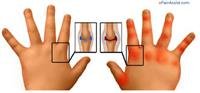
Juvenile rheumatoid arthritis (JRA) is a rheumatic disease characterized by chronic inflammation (arthritis) of one or more joints in a child age 16 years or younger. Associated symptoms typically include swelling, abnormal warmth, tenderness or pain, and/or stiffness of affected joints that tends to be worse in the mornings. In severe cases, destructive changes may eventually result in limited mobility and possible deformity of affected joints.
Some children with JRA may also have generalized symptoms and findings, such as fever, lack of appetite (anorexia), enlargement of the liver and spleen (hepatosplenomegaly), and/or other abnormalities. In addition, some forms of JRA are associated with an increased risk for inflammation of certain regions of the eyes (iridocyclitis). The range and severity of associated symptoms and findings may vary, depending upon the specific form of the disease present. The exact cause of JRA is not known.