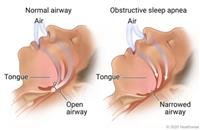
Column surgery is a minor surgery aimed at relieving habitual snoring and treating mild to moderate obstructive sleep apnea, a potentially serious disorder in which breathing repeatedly stops during sleep. Snoring and obstructive sleep apnea may occur as the muscles in the back of the throat relax.
Why is this being done
The baptismal procedure is designed to
Reducing snoring
Relieving symptoms of obstructive sleep apnea, which ranges from mild to moderate
If you have mild to moderate sleep apnea, you may be recommended to try a minimally invasive non-invasive treatment first, such as continuous positive airway pressure (CPAP). A continuous positive airway pressure (CPAP) machine uses a face mask to deliver enough air pressure into the airway to prevent blockages in the airflow. Some people may need to use continuous positive airway pressure (CPAP) even after undergoing the baptism procedure.
Not recommended for people who
You suffer from severe obstructive sleep apnea
Significant increase in weight or obesity
Snoring and obstructive sleep apnea
While you sleep, the muscles in the fleshy area at the back of your mouth (the soft palate) relax, as well as in your tongue and throat. These tissues can loosen to the point of vibration, causing snoring. Snoring can be a nuisance for you and interfere with your sleep or that of your partner. Snoring can also be a sign of obstructive sleep apnea, which is a more serious disorder.
When you have obstructive sleep apnea, the muscles in your mouth, tongue and throat may relax so badly that they block your airways, preventing you from breathing or causing you to breathe shallow several times at night. This procedure may cause a sudden in the amount of oxygen in the blood and has been linked to serious health problems such as high blood pressure and heart disease.
Other signs and symptoms of obstructive sleep apnea include restless sleep, waking up frequently, headaches in the morning, choking or gasping after pauses in breathing at night and sleepiness in the morning.
If you snore or have other signs and symptoms of obstructive sleep apnea, see your doctor. You will likely be referred to a sleep medicine specialist or a specialist in disorders of the ear, nose, and throat (a doctor or an otolaryngologist).
Risks
Studies have shown that there are some complications associated with baptism (snoring surgery). The most common complication is the protrusion of a limb from a transplanted organ through the soft palate (partial protrusion). In this case, the transplanted organ can be removed or replaced.
Other potential complications are usually temporary and resolve on their own, often within a week or so after surgery. They include:
Sore throat
Feeling of a foreign object in the soft palate
Difficulty swallowing
As with any surgical procedures, infection is a potential risk. If you develop a fever after surgery, contact your doctor.
How to prepare
You do not need to prepare for baptism (surgery to eliminate snoring) unless your doctor tells you to start taking antibiotics before your appointment.
What you can expect
During the operation
Baptism (snoring surgery) is performed in a surgeon''s office, where you will likely sit back leaning as you sit when brushing your teeth. During this less than 30-minute surgery, the surgeon:
He applies a local anesthetic to the soft palate to numb the area for injection
The area is injected with a local anesthetic, which may sting
Determines the location of the first implant
The first implant with a disposable ion device is ed
Repeat the last two steps two more times
After the operation
Your doctor may ask you to sit for several minutes to make sure you do not have significant bleeding or swelling. You should be able to complete your normal activities and eat normally on the same day.
Your doctor may prescribe an anti-inflammatory and pain reliever medication to reduce swelling and help you get rid of pain after the anesthetic wears off. Your doctor may also ask you to use an antiseptic lotion for several days and take an antibiotic to prevent infection.
Results
Research has shown that, in some people, baptismal surgery can effectively treat snoring and sleep apnea. However, this surgery does not work for everyone, and more study is needed to determine the best candidates for it.
You or your bed partner may notice fewer snoring or episodes of sleep apnea immediately after surgery. However, since the soft palate can become wrinkled over time as the tissues around the grafts harden, this may take a few months to get the full effect of the grafts.
this surgery may be beneficial, but since the surgery is relatively new, it is not certain that the grafts will continue after the short-term recovery period.