
information
Have you had a new baby and the yolk has begun to appear on it? Do you want to know the most important information about yolk in newborns? So continue with the article.
Jaundice in newborns: Here''s the most important information
Jaundice, or what is called neonatal jaundice, is a condition that affects all children in varying proportions, starting from simple and extending to serious ones. Let us know in the following the most important information and details about jaundice in newborns:
What is yolk in newborns?
Jaundice in newborns is represented by yellowing of the skin and the white part of the eyes as a result of the accumulation of unconjugated bilirubin.
Yellowing appears during the first five days of a child''s life and goes away on its own within one to two weeks without causing any problems, but in some cases bilirubin levels may rise significantly, leading to danger to the child and his life.
Types of jaundice in newborns
The types of yolk in newborns are as follows
1. Physiological yolk
Physiological jaundice affects most children after the first day of birth, and it results from a deficiency of the enzyme responsible for the process of processing bilirubin so that the liver excretes it outside the body.
As mentioned earlier, this type appears during the first five days of the child''s life and goes away automatically, as most of the time the yolk here does not rise to great proportions and does not require treatment except in a few cases.
There are factors that contribute to the physiological yolk, such as
Lack of breastfeeding by the child.
Premature birth.
Maternal diabetes.
2. Pathological yolk
Jaundice in sick newborns usually appears from the first day after birth and has many causes, which are:
The existence of a conflict between the blood of the mother and the blood of the child, and this leads to the formation of antibodies to the Rh factor in the blood of the mother and their transmission to the child’s body through the placenta, which leads to the breakage of red blood cells in the child and the excretion of bilirubin in abundance, so that the liver cannot deal with it, which leads to its accumulation quickly.
The presence of internal bleeding in a child.
The presence of obstruction in the bile ducts in the child.
High red blood cells in newborns and their short life, as their decomposition leads to the accumulation of bilirubin in the blood.
Treatment of jaundice in newborns
First, it is determined if the child needs treatment according to the following
The type of yolk, whether it is physiological or pathological.
The percentage of yolk in the blood, where the necessary laboratory tests are performed.
age of the child.
baby weight.
All of this affects the decision to start treatment or not, and the treatment is as follows:
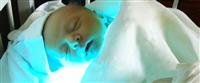
Phototherapy: It is performed by placing the child in a special photoincubator and exposing him to ultraviolet rays of a specific wavelength, which are special light waves that break down the bilirubin present in the skin.
Giving immune proteins: They are given in cases of jaundice resulting from incompatibility of the blood of the mother and the child, as they reduce the effect of antibodies that cause the breakdown of red blood cells.
Changing the baby''s blood: This method is used in severe cases in which it is feared that the yolk will lead to kernicterus, and in it the baby''s blood is exchanged to remove the yellow substance from the body.
It is worth mentioning that wrong habits must be avoided in treatment, such as: giving the child water and sugar, and placing the child under normal or neon light.
Complications of jaundice in newborns
If not treated early, a high level of yolk in the blood may lead to what is known as kernicterus due to the deposition of yellow matter in the brain, which leads to cerebral palsy.