
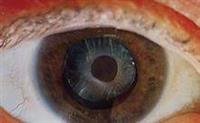
It means blurry in the lens of the eye, which in its natural state is transparent. Vision through a foggy lens is similar to trying to look through a cold or fog-covered window. Foggy vision makes reading difficult, driving a car, especially at night hours, or distinguishing the expressions of friends’ faces. Cataract usually affects vision for a distance. Distant and causing problems with farsightedness, cataracts often do not cause irritation or pain.
Most cataracts develop slowly and do not affect vision in the early stage, but as the blurring progresses, the cataract eventually affects vision. In the early stages, strong lighting and glasses may help in facing vision problems, but when vision problems threaten to change life habits, surgery is needed. Sometimes, fortunately, cataract removal is safe and mostly effective.
Types of cataract
There are three types of cataracts
1. Nuclear cataract
It is formed in the center of the lens in the early stages, and since the lens changes the way it clears, a case of myopia may arise, or a temporary improvement in vision may occur during reading, which eliminates the need for some people to wear glasses, but unfortunately this situation changes and disappears after a while because the lens begins to turn yellow. Gradually, the vision becomes more and more blurry.
Rather, the color of the lens may become brown even with the development and worsening of the cataract, and vision in dim light or driving a car at night hours may become a problematic task involving great difficulty and considerable danger, and advanced wilting may cause difficulties in distinguishing between shades of blue and violet.
2. Cortical cataract
It begins as blurred spots in the form of lines on the outer part of the lens cortex. The cataract spreads slowly and the lines spread towards the center, impeding the passage of light in the center of the lens. People with this type of cataract suffer from a general sense of dazzling.
3. Subcapsular cataract
It begins as a small plugged area just below the capsula, i.e. the outermost layer. It usually forms in an area near the back of the lens, in the path through which light passes on its way to the retina. This type of cataract causes problems with reading, impairs the ability to read in strong light, and leads to Feeling halos around light sources at night.
Symptoms of cataract disease
Cataract disease usually develops slowly and does not cause pain. The blurring initially affects only a small part of the lens and the patient is not always aware of the changes in his vision. through the lens, and the damage eventually manifests itself in general blurring or image distortion.
Effect of cataract disease on vision
When the cataract is formed and develops, the lens becomes blurry, and as a result, the light is distributed, so the image received on the retina is then blunt, which leads to blurred vision. is the core.
With age, the lens loses its softness and transparency and becomes thicker, as the lens consists mainly of water and protein fibers. The protein fibers are arranged in a way that makes the lens transparent and allows light to pass through it without obstructions. With age, the structure of the lens changes and the structure of the protein fibers disintegrates.
An intertwining occurs between a section of the fibers, as one intertwines with the other, causing blurring in small parts of the lens. The more the cataract grows and develops, the more blurring increases and spreads to a wider area of the lens. The cataract may form in any one of the parts of the lens.
Symptoms of cataract disease
Symptoms include
Blurred or dim vision.
Increasing difficulty seeing at night.
photosensitivity
halos around light sources.
Needing stronger lighting for reading or doing other work.
Frequent change of glasses or contact lenses at a high pace.
Colors become dull or yellowish.
Double vision in one eye.
For people with cataracts, sunlight may appear as the light of a lamp, or the light of an approaching car, these may appear to be very bright lights. Halos around light sources can make driving a car difficult to the point of becoming a dangerous task. People with cataracts may sometimes feel tired in the eyes. Or they may blink more frequently to clarify their vision.
Cataracts do not change the appearance of the eye. Pain, redness, itching and stimulation in the eyes, or discharge from the eye are not signs or symptoms of a cataract, but they may be indications of other eye problems.
The cataract does not pose a threat to the health of the eye unless it becomes completely white in color, which is then called a mature cataract. This situation may lead to inflammation, pain and headache. The mature cataract must be removed if it causes inflammation or pain.
Causes and risk factors for cataract disease
The cataract may develop in one eye or in both eyes, but in most cases, except for those that are the result of an injury or accident, it develops in both eyes symmetrically, and the cataract may affect the entire lens or only part of it.
When the eyes see well, the light passes through the cornea, then through the pupil, and then to the lens. The lens is thick in the middle and thin at the ends, where small bands and fibers of hard tissue hold the lens and keep it in place. The lens filters the light passing through the cornea and pupil and transmits a clear and sharp image to the retina. It is the thin, smooth membrane located in the inner posterior wall of the eyeball.
Scientists do not know exactly the exact cause of the change that occurs in the lens with age. One possibility is damage caused by unstable molecules known as free radicals. Smoking and exposure to ultraviolet light are both sources of free radicals, and the natural wear of the lens over the years. It may also lead to changes in protein fibres.
infection risk factors
Factors that increase the risk of developing a cataract include
Age.
diabetes.
Family history of cataract.
Previous injuries or infections in the eyes.
Eye surgeries.
Continuous use of corticosteroids.
Excessive exposure to sunlight.
Exposure to ionizing radiation.
smoking.
Complications of cataract disease
Complications include
Due to the nature of cataract surgery, tears of the posterior capsule may occur at any time during the procedure.
Macular cystic edema.
Endophthalmitis.
Vitreous hemorrhage.
Retinal tear.
Lens dislocation.
Diagnosis of cataract
The only way to find out if someone has a cataract is with a series of eye exams that include:
Visual acuity check.
Examination with a slit lamp.
Retinal examination.
Cataract treatment
The only useful treatment against the cataract is surgery to remove the cloudy lens. Usually during this operation a new transparent lens is also implanted. Sometimes the cataract can be removed without implanting a new lens. In these cases, vision can be fixed with glasses or contact lenses. Cataract surgeries are usually recorded. success in 95% of cases.
Since there has been a significant improvement in the methods of surgical operations and the risks of cataract surgery have become much less, it is recommended today to perform this surgery as soon as the cataract begins to affect the quality of life or the ability of the affected person to carry out routine activities.
Cataract surgery is usually performed in each of the eyes separately in clinics outside hospitals under local anesthesia, and the recovery is quick in many cases. It is possible to return to the practice of routine activity on the night of the day on which the operation was performed, and it is possible to drive the car the day after the operation after the examination.
Cataract cannot be treated and cured by medicines, food additives, sports or optical devices. In the early stages of cataract when the symptoms are mild, understanding the condition and showing readiness to adapt the lifestyle to it may help in overcoming some of its symptoms. There are various steps that can be taken. It is performed by the patient himself and on his own initiative, such as using a magnifying glass for reading or improving the lighting of the house, which will help counteract the effects of cataracts.
Prevention of cataract disease
Regular and routine eye examination is the key to early detection, and for people over the age of 65, it is recommended to conduct an eye examination every two years. They include:
stop smoking.
Sun protection.
Treating other health problems.