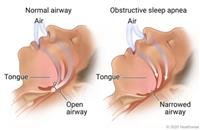
Snoring can be treated by expanding the upper airways and removing the vibrating tissues that are the main cause of snoring, which prevents the occurrence of some problems that may result from it, such as: Obstructive sleep apnea.
Risks of snoring treatment
Snoring treatment is associated with many risks, such as the following
severe pain after surgery
Having sleep apnea.
Palate problems.
prior to the operation
You should avoid taking aspirin ten days before the surgery, and you should stop smoking as much as possible to avoid excessive coughing after surgery.
during the procedure
Snoring can be treated in many ways, such as the following
Uvulopalatopharyngoplasty
The tonsils are removed, the palate is shortened, the mucous membranes are sutured, the vibrating tissues are removed, and the volume of the pharyngeal cavity is increased. The success rates of this method are high if it is performed to the fullest.
other ways
These include
Treatment of snoring by means of laser or sound waves, and shortening of the epiglottis, but these methods are still less effective than the traditional method.
Post-operation
Snoring is expected to worsen after the procedure due to swelling of the tissues, and the condition usually begins to improve within a week or two of the operation.