
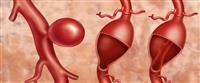
may affect the arteries of the brain
What is a cerebral aneurysm? What are its symptoms and causes? What are the available treatment methods? And how dangerous is it for health? Read the article to know the answer.
In what follows, we will introduce you to brain aneurysm, which is a medical problem known by several other common names, such as: intracranial aneurysm, cerebral aneurysm, and brain aneurysm.
What is a cerebral aneurysm?
A cerebral aneurysm is a health problem that may arise as a result of a weakness in the wall of one of the blood arteries in the brain that may cause it to swell.
The areas of the brain most susceptible to cerebral aneurysms are the areas in which arteries branch, especially the arteries within the Circle of Willis, a network of blood vessels located near the base of the brain.
Many people do not realize that they have a brain aneurysm except by chance while they are taking some medical pictures, as most of the injured do not show any symptoms except when any of the following occurs:
A rupture of the affected artery.
Increase in the size of the cerebral aneurysm.
Blood leakage from the affected artery without rupture.
Some cases of cerebral aneurysm do not need to undergo any treatment, but in other cases, the patient''s failure to obtain the necessary medical care may cause the affected artery to rupture, and this rupture is a medical emergency, as it may kill the patient or may leave him with severe and permanent brain damage.
Types of cerebral aneurysm
Cerebral aneurysms have several different types, the most prominent of which are
Saccular aneurysm: It is the most common type, and it appears in the form of a bump resembling a small berry.
Fusiform aneurysm: This type usually causes multiple bumps in the walls of the affected artery and an expansion of the artery.
Dissecting aneurysm: This type arises as a result of a rupture in one of the three layers that make up the wall of the affected artery, so that blood begins to leak from one layer to another.
Causes of cerebral aneurysm
A cerebral aneurysm begins in the form of weakness or thinning in a specific area of the muscular wall of one of the blood arteries in the brain, and with the continuation of blood flow through the affected artery, the pressure imposed on the weakened area may increase, which may over time stimulate the formation of a balloon-like bulge. in the artery wall.
Risk factors for cerebral aneurysm
These are some of the factors that may increase the chances of weakening the walls of the brain arteries:
Having health problems in the circulatory system, such as arteriovenous malformation and high blood pressure.
Head injury, such as: having an accident in the head area, and brain tumors.
Other infections, such as: Polycystic kidney disease, diabetes, and connective tissue diseases.
Adopting an unhealthy lifestyle, which may include: excessive drinking of alcohol, use of tobacco, and drug use.
Other factors, such as: heredity, genes, and gender, as the condition is more common among females.
Symptoms of cerebral aneurysm
Here is a list of the most important ones
1. Symptoms of a non-ruptured cerebral aneurysm
A non-ruptured cerebral aneurysm may cause certain symptoms when it grows in size, as its increase in size may cause increased pressure on the nerves and tissues in its surroundings, which may lead to symptoms such as:
Pain behind the eye or around the eye.
Mydriasis in one eye.
Eyelid drooping.
Visual problems, such as double vision.
Numbness or even paralysis on one side of the body.
2. Symptoms of a leaky cerebral um
Sometimes blood may begin to leak from the affected artery, and here the apparent symptoms may be limited to feeling a sharp and sudden headache, nothing more.
3. Symptoms of a ruptured cerebral aneurysm
A ruptured cerebral aneurysm may cause the following symptoms
A sudden and painful headache that is difficult to bear.
sensitivity to light
Nausea and vomiting.
Neck stiffness and spasm.
Eyelid drooping.
Other symptoms, such as: double vision, loss of consciousness.
Diagnosis of cerebral aneurysm
These are the most important tests that may help diagnose the condition
Cerebral angiography.
Cerebrospinal fluid analysis.
Brain imaging using computed tomography.
Methods of treating cerebral aneurysm
Some cases of cerebral aneurysm may not require treatment, and here the following may be resorted to:
Follow-up and monitoring of the condition by subjecting the patient to cerebral angiography examination on a regular basis.
Making some life changes, such as: quitting smoking, and always maintaining moderate blood pressure.
These are the most prominent therapeutic methods that may be followed with patients whose condition requires treatment:
Microvascular clipping: A metal tool is placed near the root of the aneurysm to prevent its size from increasing.
Endovascular flow diversion: A specific tool is ed into the affected area to reduce blood flow to the site of the aneurysm.
Endovascular coil embolization: A specific tool is ed that may help the aneurysm clot.
If a rupture occurs in the brain stem, this may lead to serious complications, such as: subarachnoid haemorrhage, hemorrhagic stroke, brain damage, and coma.