
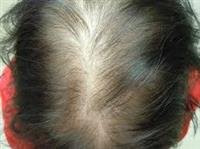
Female Pattern Baldness: Mistakenly thought to be a strictly male disease, women make up a significant percentage of American hair loss sufferers. Forty percent of women have visible hair loss by the time they are age 40, according to the American Academy of Dermatology. Hair loss in women can be absolutely devastating for self image and emotional well-being. The American Hair Loss Association recognizes that hair loss in women is a serious life- ing condition that can no longer be ignored.
Male Pattern Baldness: The male pattern baldness (MPB) form of androgenetic alopecia (there is also a female pattern baldness) accounts for more than 95% of hair loss in men. By age 35, two-thirds of American men will have some degree of appreciable hair loss and by age 50 approximately 85% of men have significantly thinning hair. About 25% of men who suffer from male pattern baldness begin the painful process before they reach 21. Contrary to societal belief, most men who suffer from male pattern baldness are extremely unhappy with their situation and would do anything to change it. Hair loss affects every aspect of their life. It affects interpersonal relationships as well as their professional life. It is not uncommon for men to change their career paths because of hair loss
Surgical approaches include various versions of hair transplantation (taking hair from the back and putting it near the front) or scalp reduction (cutting away bald areas and stitching the rest together). Transplant procedures have improved greatly in recent years. They can produce much more attractive and natural-looking results than older methods that sometimes left a "checkerboard" look. Many transplant patients now take Propecia to keep what they've transplanted. When considering a hair transplant, check the surgeon's credentials and experience carefully.
Low level light laser therapy (LLLT) has been used to treat a variety of medical disorders from ulcers to musculoskeletal disorders. In 2007, a low level light device was approved by the U.S. Food and Drug Administration (FDA) to treat male pattern hair loss.
The laser comb is a handheld device that was approved as a device which has a different standard for FDA approval than a medication. The device is sold over the counter without physician prescription or physician monitoring.
Low level light laser therapy (LLLT) has been used to treat a variety of medical disorders from ulcers to musculoskeletal disorders. In 2007, a low level light device was approved by the U.S. Food and Drug Administration (FDA) to treat male pattern hair loss.
There are various manufacturers of light therapy devices that are sold to physician's offices that are not handheld, such as the Sunetics device.
"Premature graying is genetically determined for the most part," David Bank, MD, tells WebMD. Bank is director of the Center for Dermatology, Cosmetic, and Laser Surgery in Mount Kisco, N.Y. "Graying is natural. We all do it eventually."
When more than half the hair is white by age 40, though, this is considered "premature."
Bank also points out that head hair grows more actively than body hair. So the head can go gray while other hairy parts remain your normal color. Correction: Your former color.
Razor bumps, also called pseudofolliculitis barbae, are small, irritated bumps on the skin. They develop after shaving, when strands of hair curl back on themselves and grow into the skin. Razor bumps cause irritation and the development of pimples. They also may cause scarring.
Razor bumps are common among African-Americans and people with tightly coiled hair. Razor bumps tend to be more of a problem for men than women, because many men shave daily.