Test Overview
A computed tomography (CT) scan uses X-rays to make detailed pictures of structures inside of the body.
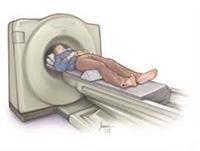
During the test, you will lie on a table that is attached to the CT scanner, which is a large doughnut-shaped machine. The CT scanner sends X-rays through the body area being studied. Each rotation of the scanner provides a picture of a thin slice of the organ or area. All of the pictures are saved as a group on a computer. They also can be printed.
In some cases, a dye called contrast material may be used. It may be put in a vein (IV) in your arm, or it may be placed into other parts of your body (such as the rectum or a joint) to see those areas better. For some types of CT scans, you drink the dye. The dye makes structures and organs easier to see on the CT pictures.
A CT scan can be used to study all parts of your body, such as the chest, belly, pelvis, or an arm or leg. It can take pictures of body organs, such as the liver, pancreas, intestines , kidneys , bladder , adrenal glands, lungs, and heart. It also can study blood vessels, bones, and the spinal cord.
Fluoroscopy CT is a special test that is not widely available. It uses a steady beam of X-rays to look at movement within the body. It allows the doctor to see your organs move or to guide a biopsy needle or other instrument into the right place inside your body.
Why It Is Done
CT scans are used to study areas of the body and the arms or legs.
Chest (thorax). A CT scan of the chest can look for problems with the lungs, the heart, the esophagus , or the major blood vessel (aorta) or the tissues in the center of the chest. Some common chest problems a CT scan may find include infection, lung cancer, a pulmonary embolism, and an aneurysm. It also can be used to see if cancer has spread into the chest from another area of the body.
Abdomen. A CT scan of the abdomen can find cysts, abscesses, infection, tumors, an aneurysm, enlarged lymph nodes, foreign objects, bleeding in the belly, diverticulitis, inflammatory bowel disease, and appendicitis.
Urinary tract. A CT scan of the kidneys , ureters, and bladder is called a CT KUB or CT urogram. This type of scan can find kidney stones , bladder stones, or blockage of the urinary tract . A special type of CT scan, called a CT intravenous pyelogram (IVP), uses injected dye (contrast material) to look for kidney stones, blockage, growths, infection, or other diseases of the urinary tract.
Liver. A CT scan can find liver tumors, bleeding from the liver, and liver diseases. A CT scan of the liver can help determine the cause of jaundice.
Pancreas. A CT scan can find a tumor in the pancreas or inflammation of the pancreas (pancreatitis).
Gallbladder and bile ducts. A CT scan can be used to check for blockage of the bile ducts. Gallstones occasionally show up on a CT scan. But other tests, such as ultrasound, usually are used to find problems with the gallbladder and bile ducts.
Adrenal glands. A CT scan can find tumors or enlarged adrenal glands.
Spleen. A CT scan can be used to check for an injury to the spleen or the size of the spleen.
Pelvis. A CT scan can look for problems of organs in the pelvis. For a woman, these include the uterus, ovaries, and fallopian tubes. For a man, the pelvic organs include the prostate gland and the seminal vesicles.
Arm or leg. A CT scan can look for problems of the arms or legs, including the shoulder, elbow, wrist, hand, hip, knee, ankle, or foot.
Other uses for a CT scan
A CT scan may be used to make sure a procedure is done correctly. For example, the doctor may use CT to guide a needle during a tissue biopsy or to guide the proper placement of a needle to drain an abscess.
For people with cancer, a CT scan can help determine how much the cancer has spread. This is called staging the cancer.
How To Prepare
Before the CT scan, tell your doctor if you
Are or might be pregnant.
Are allergic to any medicines, including iodine dyes.
Have a heart condition, such as heart failure.
Have diabetes.
Take metformin. You may have to adjust your medicine for a day before and after the test.
Have had kidney problems.
Have asthma.
Have had multiple myeloma.
Have had an X-ray test using barium contrast material (such as a barium enema) in the past 4 days. Barium shows up on X-ray films and makes it hard to see the picture clearly.
Become very nervous in small spaces. You need to lie still inside the CT scanner, so you may need a medicine (sedative) to help you relax.
Arrange for someone to take you home in case you get a medicine to help you relax (sedative) for the test.
If you have a CT scan of your belly, you may be asked to not eat any solid foods starting the night before your scan. For a CT scan of the belly, you may drink contrast material. For some CT scans, you may need a laxative or an enema before the test.
Talk to your doctor about any concerns you have regarding the need for the test, its risks, how it will be done, or what the results will mean. To help you understand the importance of this test, fill out the medical test information form(What is a PDF document?).
How It Is Done
A CT scan is usually done by a radiology technologist. The pictures are usually read by a radiologist, who writes the report. Other doctors also may review a CT scan.
You may need to take off any jewelry. You will need to take off all or most of your clothes, depending on which area is studied. You may be able to wear your underwear for some scans. You will be given a gown to use during the test.
During the test, you will lie on a table that is attached to the CT scanner.
The table slides into the round opening of the scanner, and the scanner moves around your body. The table will move while the scanner takes pictures. You may hear a click or buzz as the table and scanner move. It is very important to lie still during the test.
During the test, you may be alone in the scan room. But the technologist will watch you through a window. You will be able to talk to the technologist through a two-way intercom.
The test will take about 30 to 60 minutes. Most of this time is spent getting ready for the scan. The actual scan only takes a few seconds.
How It Feels
The test will not cause pain. The table you lie on may feel hard, and the room may be cool. It may be hard to lie still during the test.