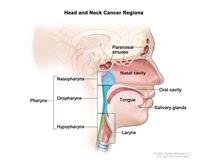
Head and neck tumors are those that grow in the nose, sinuses, mouth, throat, voice box, salivary glands, lymph nodes in the neck, thyroid gland or parathyroid glands. They can be cancerous or noncancerous (benign).
Signs You Should Get Help for Head and Neck Tumors
Because head and neck cancers can spread quickly to nearby lymph nodes or other parts of the body, including the lungs, it’s important to get a fast, accurate diagnosis. See your primary care doctor if you experience any of the following symptoms:
A lump or sore that does not heal
Bleeding through the nose
Changes in your voice or hoarseness
Chronic sinus infections that do not respond to treatment with antibiotics
Numbness or paralysis of the muscles in the face
Pain in the face, chin, neck or throat that does not go away
Sinuses that are blocked and do not clear
Sore throat that does not go away
Swelling or other trouble with the eye
Unusual bleeding or pain in your mouth
White or red patch on the gums, tongue or lining of the mouth
Many of these are symptoms of multiple conditions, so it’s important to be evaluated by a doctor to get an accurate diagnosis.
Care for Head and Neck Tumors at Rush
Head and neck tumors can be challenging to treat because they grow near the brain, spine, vital nerves and major blood vessels. Removing them can affect a person''s ability to eat, speak, see, hear, smell or taste.
Your treatment depends on the following
Where the tumor is located
The stage of the cancer (if your tumor is cancerous)
Your age and general health
You''ll have a multidisciplinary team of head and neck cancer specialists dedicated to your care. We focus on effectively treat your tumor while, as much as possible, preserving your appearance and quality of life. Your personalized treatment plan may involve one or more of the following:
Monitoring: For noncancerous head and neck tumors that are not causing symptoms, your doctor may recommend a wait-and-see approach. If the tumor grows and starts causing problems, it may need to be removed.
Surgery: At Rush, some head and neck tumors can be removed through a minimally invasive approach that allows you to go home sooner — and results in a faster recovery with less pain. Surgeons at Rush offer the latest surgical techniques, including transoral robotic surgery, or TORS and sentinel lymph node biopsy.
Radiation therapy (intensity-modulated radiation therapy or proton beam therapy) is commonly used for these reasons:
After surgery, to destroy any remaining tumor cells
To treat tumors that recur (come back)
To try and slow the growth of tumors that can’t be removed with surgery
Chemotherapy, used alone or combined with radiation therapy and/or surgery
Targeted therapy drugs may help stop or slow the growth of certain types of head and neck cancer
Rehabilitation is an important part of head and neck tumor care. Often, surgery to remove a head and neck tumor can affect a person’s ability to speak, swallow or eat. In these cases, you may be referred for one or more of the following:
Physical therapy
Occupational therapy
Speech therapy
Dietary counseling
Reconstructive and plastic surgery may be needed after tumor removal surgery to rebuild bones or tissues.
Rush Excellence in Head and Neck Tumors
Effective, minimally invasive treatment: Your care team at Rush will provide the least invasive but most effective treatment possible, including minimally invasive surgery and targeted radiation therapy that kills microscopic tumor cells.
Leaders in innovation: For head and neck cancers, skull base and head and neck surgeons have expertise in transoral robotic surgery (TORS) and image-guided skull base techniques, which allow for significantly less scarring than open procedures. Typically, open surgeries require the splitting of bones and other structures in the mouth and throat. In contrast, with a TORS procedure, patients typically have a scar of several millimeters and no splitting of the bones.
Nationally ranked care: U.S. News & World Report ranked Rush University Medical Center among the best in the nation for ENT and cancer care.
Accredited cancer care: Both Rush University Cancer Center and Rush Copley Cancer Center are fully accredited by the Commission on Cancer (CoC) of the American College of Surgeons. CoC accreditation shows that Rush is committed to providing patients and their families with quality services to diagnose, treat, rehabilitate and support those dealing with cancer.
Leaders in research: As a leading academic health system, Rush offers national. multi-institutional and investigator-initiated clinical trials. Through clinical trials, you may have access to new treatment options and therapies that are not widely available. Talk to your providers about if a clinical trial may be right for you.
Supportive care: Our team is dedicated to helping you through all aspects of your care, including your emotional health. Our Supportive Oncology Program provides psychosocial counseling, nutritional counseling, acupuncture and massage. The team can also connect you to other resources, such as financial counseling and transportation assistance, to help you and your family before, during and after treatment.
Personalized treatment through genetic data: Our partnership with Tempus, a biotechnology company, helps us further personalize your head and neck cancer care through genetic testing that can help zero in on the most effective treatments for you.