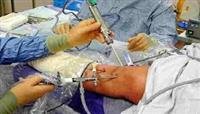
A knee joint replacement operation aims to treat the wear of cartilage in the knee joint, which often occurs as a result of chronic arthritis (Arthritis), and the operation depends on replacing the affected joint with another artificial joint.
Risks of performing the operation
Knee replacement surgery is associated with some risks, as follows
Infection in the surgical incision.
bleeding.
Scars in the incision area.
Severe in blood pressure.
Damage to the nerves around the joint.
Damage to ligaments or muscles.
Fat Embolism.
Before knee replacement surgery
The patient is sent for tests that vary according to the patient’s age and diseases, such as: complete blood count, blood chemistry, blood clotting, urine test, kidney and liver function, electrocardiograph, and chest x-ray.
The doctor sends the patient for an imaging examination of the knee using X-rays, computed tomography of the knee, and magnetic resonance imaging.
The surgeon must be consulted about the medications that must be stopped in the days preceding the operation, and you must fast completely for 8 hours before the operation.
during operation
After anesthesia and sterilization of the area completely, an incision is made with a length of 8-12 centimeters in the front part of the knee, then the surgeon removes the excess cartilage and bone tissue that is pressing on the knee joint.
After that, the artificial joint is attached to the femur and tibia using a suitable adhesive, and then the artificial joint is attached to the knee muscles and the ligaments supporting the joint to obtain a motor performance in the joint similar to the natural position.
After the operation
The patient stays in the hospital for several days after the operation to ensure that his condition is stable, and pain relievers can be used as needed.
You should go to the doctor immediately in cases where some symptoms appear, such as: severe pain, loss of sensation, headache, high body temperature, and bleeding from the wound.
The pain completely disappears after several weeks of the operation, and the patient is advised to walk on the foot gradually, with the need to avoid bending the knee joint.