
An undescended testicle is one of the problems that occur when the testicle does not descend to the place prepared for it inside the scrotum, which is located behind the penis before the birth of a male baby. About 2-5% of all male newborns suffer from undescended testicles in one or both testicles, and this problem is common in cases of premature birth.
or before the completion of 37 weeks of pregnancy.
The testes are formed inside the abdominal cavity (Abdominal cavity) during the period of fetal development, and in the last two months of normal pregnancy, the testicle gradually leaves the abdominal cavity, and passes through a tube-like passage into the inguinal canal (Groin), and then is stationed inside the scrotum.
In cases of undescended testicles, the process of testicular development stops at a certain stage, which means that it will not be possible to see the testicle, or feel it in the place where it is expected to be, i.e. inside the scrotum.
In cases where one testicle is not descended, or both, the problem resolves on its own during the first months of the infant’s life. scrotum.
Undescended testicle symptoms
The condition of the undescended testicle is discovered when the infant undergoes the first physical examination immediately after birth, and in the event that there is a problem of the undescended testicle, the doctor should be consulted to find out the periods during which the doctor should be reviewed for re-examination.
In the event that the problem persists until the child reaches the fourth month of life, this means that the condition must be treated as soon as possible to reduce the possibility of complications arising in advanced stages of life, such as: infertility or testicular cancer.
Some children may suffer from the disappearance of the testicle at a later stage of their lives, in some cases in which the testicle descends during the birth process, and this may indicate the following:
Wandering testicle: The testicle moves back and forth between the scrotum and the groin, and the doctor can return it manually and easily.
Testicle rises: The testicle has risen into the groin and cannot be returned to the scrotum easily in this case.
Causes and risk factors for an undescended testicle
The exact cause of testicular disappearance is still unknown, as it could be a combination of several factors, such as the following:
Genetic factors.
The mother''s health condition.
hormonal disorders.
disturbances in nervous activity
Factors that may increase the risk of developing an undescended testicle
They include the following
Low birth weight - LBW.
Preterm birth.
Family history of undescended testicles, or other problems related to the proper development of the reproductive organs.
Down syndrome, or the appearance of defects in the abdominal wall.
The mother consumed alcoholic beverages and smoked during pregnancy.
The mother smokes cigarettes, or is exposed to secondhand smoke during pregnancy.
The mother has a type of diabetes, such as type 1 diabetes, type 2 diabetes, or gestational diabetes.
Exposure of parents to different types of pesticides.
Complications of an undescended testicle
The testicles must remain at a temperature below body temperature, to ensure that they continue to function properly, as the scrotum provides this appropriate environment, and when the child reaches 3 or 4 years of age, the testicles undergo certain changes that affect the way the testicles perform in the future.
The absence of the undescended testicle in an environment cooler than body temperature may cause the emergence of many complications, such as the following:
Testicular cancer
Testicular cancer begins its development in the tissue of testicular cells responsible for sperm production (sperm), and there is no exact reason for these cells to turn into cancerous cells, but men who suffered in their childhood from a condition of undescended testicles are more likely to develop testicular cancer.
Fertility problems
Men who suffered from cryptorchidism in their childhood are more likely to suffer from some problems, such as: low sperm count and quality, and infertility.
Additional complications may also occur if the testicles are located in an abnormal location, or if the testicles disappear, and include the following:
Testicular torsion
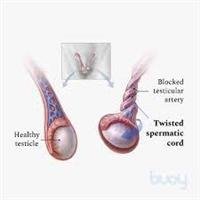
Testicular torsion occurs when the duct that contains blood vessels, neural networks, and the semen duct that connects semen from the testicles to the penis wraps, causing severe pain and stopping blood flow to the testicle. If the condition is not treated immediately, this can lead to to testicular loss.
Damage to the testicle
If the testicle is in the groin canal, damage to the testicle may occur as a result of the pressure on it from the pubic bone.
Inguinal hernia
An undescended testicle may lead to an inguinal hernia, and if the opening between the abdominal cavity and the inguinal passage is too soft, pressure may arise on some internal organs in the abdominal cavity, causing an inguinal hernia.
Diagnosis of an undescended testicle
The attending physician can determine relatively easily if one of the testicles has not descended to the place prepared for it in the scrotum, and future examinations are performed to determine the exact location of the testicle and track changes that occur in its place.
In the event that the testicle is located in the groin, the attending physician can determine its location by feeling only manually. In order to ascertain the condition, as approximately 10% of undescended testicle cases cannot be felt, we mention the following from these examinations:
Ultrasound imaging.
Magnetic resonance imaging - MRI.
Laparoscopy examination.
Perform open surgery.
Other cases should be examined
If the child suffers from failure to descend in both testicles, the doctor will refer him to conduct a number of additional examinations in order to accurately determine the sex of the child. The newborn is a hermaphrodite (Intersex).
The examinations that must be performed to determine whether the phenomenon is intersexuality or not include the following:
Measure levels of several types of hormones in blood and urine.
Examination of the genes responsible for determining the sex of the child.
Examination of the presence of female genital organs (ovaries).
Undescended testicle treatment
Medical treatment aims to move the undescended testicle and return it to its place inside the scrotum, and treatment in the early stages aims to reduce the risk of any complications, such as the following:
surgery
The undescended testicle is treated by surgery, where the doctor pulls the undescended testicle gently and softly towards the scrotum, then fixes it in place with a stitch. This operation requires opening a few small incisions in the area, and it can be performed using endoscopic means.
The surgeon recommends that this surgery be performed after the child completes 3-6 months of age, and the time of the operation depends on the general health of the child and the complexity of the surgery.
In certain cases, there may be an abnormality in the development of the testicle, so that there is abnormal tissue or dead tissue, and in such cases, the surgeon removes the abnormal tissue.
In the event that the child suffers from an inguinal hernia associated with the undescended testicle, then the hernia is repaired during the same surgery.
After the surgery, the doctor follows up on the condition of the testicle in order to check and monitor its development over time. The process includes following up the following procedures:
Do a physical examination.
Ultrasound imaging of the scrotum.
Checking hormone levels.
hormonal therapy
Hormonal therapy consists in injecting the human chorionic gonadotropin (HCG), which helps to make the testicle move towards the scrotum, and this treatment is usually less effective than surgery, and it may lead to early puberty, or what is called maturation. early sexual
Other treatments
In the event that there is a shortage of one or two testicles in the child, as a result of the phenomenon of the undescended testicle, or in the event of failure of surgeries, it is possible to consider the possibility of implanting an artificial testicle in the form of a small bag filled with fluid inside the scrotum, which is an operation that is usually performed late in childhood.
In the event that the child does not have any testicles working properly, the child is referred to an endocrinologist With the aim of discussing future hormonal treatments To ensure a healthy sexual development.
Prevention of undescended testicle
Since the exact cause of this problem is not known Therefore, there is no clear way to prevent an undescended testicle.