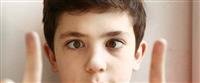
and a squint?
We may confuse some concepts when referring to a lazy eye and strabismus or to answer the following question: What does your son/daughter have a lazy eye or strabismus? Amblyopia or lazy eye is a decrease in the degree of vision of one eye due to an error in the coordination of brain signals. It can happen in one or both eyes, but it is most common
Wen in one eye only. And because brain signals give preference to the healthy eye, the other eye is not stimulated and does not perform its function adequately. Deviation of the eye causes what we know as strabismus. The squint can be towards the outside, towards the inside, or up or down.
Amblyopia occurs at a very early age and is the number one cause of vision loss in children. Therefore, it becomes necessary to take the child to the ophthalmologist to conduct the necessary medical examination early to find out the causes of amblyopia as soon as possible.
Risks of amblyopia or lazy eye
There are several visual diseases that may lead to amblyopia, so it must be treated quickly for several reasons, including:
Over time, an amblyopic eye can become permanently blind.
May lose depth perception or (3D vision)
If the healthy eye is exposed to disease or damage, the amblyopic eye cannot be used to compensate for the loss of vision.
Distinguish between lazy eye and strabismus
There is a lot of confusion between the concepts of lazy eye and strabismus. The majority of people when they refer to the lazy eye, they describe it as a deviation or distortion of vision, i.e. strabismus. While lazy eye is part of amblyopia and causes decreased vision in one eye. To understand the differences between a squint and a lazy eye, i.e. amblyopia, the imbalance of the eyes (squint) may lead to amblyopia (lazy eye).
People with strabismus confirm the same symptoms, that is, the deviation of the eyes, their intersection, or their overlapping. When the direction of vision varies between one eye and the other, this means that it is a case of strabismus. And for some reason, the squint, one of the eyes loses the ability to see well, because the brain does not send its instructions, and it becomes a lazy eye for not performing its job (amblyopia).
Lazy eye treatment
There is no surgical procedure to treat amblyopia or lazy eye. This is possible if it was treated in childhood. And the earlier it is diagnosed and treated, the better. In fact, the success rate of treatment is declining for children at the age of 7 years, with the existence of exceptional cases that allow treatment of the condition until the age of 15 years. Amblyopia can usually be treated with eyeglasses, hooding, or medication. The use of eye patches in which the child is forced to use the weaker eye in order to correct his vision. Also, glasses can be used to cover the healthy eye and for the weak eye to function properly. This exercise can last for weeks or months. When the lazy eye begins to function with vision, the child can then put eye patches less frequently, that is, intermittently for some years, in order to maintain the degree of vision that the weak eye has gained.
Strabismus treatment
In fact, there is no surgery for the lazy eye, but this concept was known because of the confusion between the case of strabismus (eye deviation) and the case of the lazy eye or amblyopia. Therefore, what is meant to be referred to here is, in fact, the surgical operation of strabismus, which is a surgical intervention at the level of the eye muscles in order to correct the deviation. Children and adults can undergo this operation, and its results have a role in improving the visual functioning of the eye, as well as improving its external or aesthetic appearance.
When there is a case of squint, it is important to see the following information
Strabismus can be treated in some cases with glasses, and it may be accompanied by covering one eye.
But if the first solution is not enough, i.e. glasses, it can be treated medicinally without the need for surgery, and the drugs work to relax the muscles.
And in cases where these solutions, i.e. glasses, covering one eye, and medications fail to correct the squint, it is necessary to resort to the surgical procedure.
The surgery involves tightening and relaxing the eye muscles in order to adjust them and make them parallel.
There are two main types of strabismus surgery
Firstly, retracting the eye muscles (weakening them), which means separating the muscle and reassembling it in another part, far from the front part of the eye.
Muscle cutting (strengthening) i.e. removing part of the muscle to tighten it more.
Eye muscle modification surgery has high success indicators and serious complications are rare.
It is a type of clinical operation that does not require the patient to stay in the hospital.
Children can return to school after a few days of rest. In the case of adults, they can return to their work weeks after the operation.
The usual side effects caused by the squint operation are redness, discomfort and pain, but they are generally temporary.
If you are thinking of having a squint operation, whether for your child or child, or even for yourself, it is important at first to conduct an examination with an ophthalmologist who specializes in squint to discuss expectations and possibilities in advance.