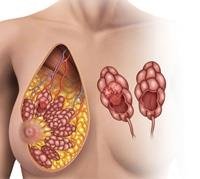
It is important to conduct examinations for the early detection of benign tumors in order to avoid their spread and to provide appropriate treatment. What is fibroadenoma in the breast? Fibroadenoma is one of the most common types of breast conditions, and these tumors usually begin to appear during puberty and are
More likely in young girls to present as one or more lumps in one or both breasts.
It is possible to develop this type of tumor at any age, and men may also develop it, but this is rare.
Types of fibroadenoma of the breast
Types of fibroadenoma in the breast include the following
1. Simple fibroadenoma
The size of the lumps in this type of benign breast tumor ranges between 1-3 centimeters, and the appearance of this type of tumor in the breast does not make the affected woman more likely than others to develop breast cancer.
2. Complex fibroadenoma
Unlike the first type, a complex breast tumor may increase a woman''s risk of developing breast cancer, but it never turns into a cancerous tumor.
3. Giant or juvenile fibroadenoma
Sometimes a benign breast tumor may grow to more than 5 centimeters in size, and then it turns from a simple or complex tumor into a giant tumor, and unlike cancerous breast tumors, benign breast tumors will not cause secretions from the nipple, or any type of breast tumor and redness And a rash around it.
Symptoms of fibroadenoma of the breast
One or more lumps may appear in the breast, and these lumps often range between 1-2 centimeters in diameter, but in some cases they may grow to be more than 5 centimeters in diameter, and their characteristics are as follows:
Chewy texture.
Circular or regular in shape and well-defined.
Movable under the skin when felt.
It is painless except in rare cases, as it becomes soft and somewhat painful, especially in the pre-menstrual period.
How does fibroadenoma form in the breast?
There is no specific reason yet for the appearance of benign breast tumors, but many specialists believe that these lumps arise and develop as a result of changes in estrogen levels in the body.
The breast consists of lobules, which are milk-producing glands, and ducts that carry milk and connect it to the nipple (Ducts), and these glands and ducts are surrounded by fatty tissues that protect them, and a benign breast tumor begins to form in one of the milk lobules to enlarge the tissues and milk ducts Finally, a cohesive and soft mass is the benign tumor.
Most susceptible to fibroadenoma of the breast
Benign breast tumors are common among many women and girls in general, as about 10% of women often develop them without realizing it, and this type of tumor is also common in:
Girls and women between 15 - 35 years of age.
Women during pregnancy or breastfeeding.
It is worth noting that it was found that the presence of a woman in the family who had previously had breast cancer may increase the chances of developing this type of benign tumor, and often one mass arises in the breast, except in cases where more than one mass appears at the same time or at different stages of life. different, which constitutes 10% - 15% of all infected cases.
Diagnosis of fibroadenoma of the breast
When a woman feels the presence of a mass in the breast, she must visit the doctor, and in this case it is expected that the doctor will refer the patient to a clinic specializing in breast problems, and there the woman will perform several examinations that are conducted in a medical procedure called the triple assessment to reach the diagnosis Exactly, these checks are as follows:
External manual breast examination.
Ultrasound scan, or mammography.
A core biopsy, or fine needle aspiration (FNA).
It must be noted that the younger the girl with a benign breast tumor, the less severe the measures taken, and that she may not even have to resort to the triple evaluation with all its three procedures, as a mere manual breast examination and ultrasound examination may be sufficient and not necessary. to take a biopsy.
If the woman is under the age of 40 years, she will often need to undergo an ultrasound examination instead of a mammogram. If the girl is young, the tissue mass in the breast will often be more solid and its structure more dense, which may make the results of the mammogram less clear, but this It does not eliminate the need to reach a correct and integrated diagnosis.
Treatment of fibroadenoma of the breast
There are several ways to deal with and get rid of a benign tumor
1. Monitoring benign breast tumors without excision
Especially if it''s small and doesn''t seem to be getting bigger with time, staying there probably won''t do any harm.
2. Surgical solution
Includes one of two options
Excisional biopsy: This is a surgical procedure used to remove complex or giant benign breast lumps.
Vacuum assisted excisional biopsy: This procedure does not require a large surgical incision in the chest as in the aforementioned type, and it can be performed under local anesthesia.
This type of medical procedure is usually used in the event that the mass or benign masses in the breast are small in size, and here a vacuum tube is ed through a small incision in the breast so that the tumor is sucked out completely, while observing what is happening inside the breast and making sure that the tube enters to the correct locations by observing the breast internally with a live mammogram on a monitor being monitored by the physician.
The lumps that are removed are then sent to the laboratory for examination, and it is worth noting that this procedure may cause some swelling and pain for several days.
3. Cryoablation
In it, the doctor monitors the benign tumor in the breast through ultrasound waves on the screen of a dedicated device, while holding an electronic tool called a cryoprobe, which he gently presses on the skin of the breast, which freezes the tissue surrounding the tumor, which leads to the destruction of the benign mass without surgery.
The removal of benign breast tumors does not affect the shape and structure of the breast in general, but this does not prevent the possibility of a gap-like appearance and is almost invisible in the place the mass occupied before the removal, and often you will not have to undergo any follow-up procedures for your condition after the removal of the tumors.
If you choose not to remove the tumors due to their small size, the doctor may ask you to monitor the tumors in order to ensure that they do not increase in size. Most benign tumors that appear in the breast are often small in size and remain small in size, and some fade and disappear with time without any surgical intervention.
In very few cases, benign lumps in the breast increase in size, especially those that appear in teenage girls, and hormonal changes in general in a woman’s body may stimulate benign breast tumors to grow and enlarge during pregnancy or lactation, but they return to smaller after the return of hormones to their normal levels.