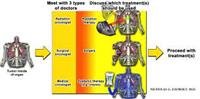

Radiation is a form of intense energy generated by a radioactive substance, such as cobalt, or by specialized equipment, such as an atomic particle (linear) accelerator.
Radiation preferentially kills cells that divide rapidly and cells that have difficulty repairing their DNA. Cancer cells divide more often than normal cells and often cannot repair damage done to them by radiation. Therefore, cancer cells are more likely than most normal cells to be killed by radiation. Nonetheless, cancer cells differ in how easily they are killed by radiation. Some cells are very resistant and cannot be effectively treated with radiation.
(See also Cancer Treatment Principles.)
Types of Radiation Therapy
The most common form of radiation therapy used in cancer treatment is
External beam radiation
Another form of radiation therapy is
Internal radiation
Radioactive substances can also be attached to proteins called monoclonal antibodies, which seek out cancer cells and attach to them. The radioactive material attached to the antibody concentrates at the cancer cells and destroys them.
External radiation therapy
In radiation therapy, a beam of gamma or x-rays, alpha particles, or electrons is aimed at the person''s cancer. Radiosurgery is a type of radiation therapy in which very focused beams of radiation are used.
There are several types of external beam radiation, including
Three-dimensional conformal radiation (3D-CRT)
Intensity-modulated radiation therapy (IMRT)
Image-guided radiation therapy (IGRT)
Tomotherapy
Stereotactic radiosurgery
Stereotactic body radiation therapy
Proton beam radiation
Electron beam radiation therapy
All types of external radiation are focused on the particular area or organ of the body that contains the cancer. To avoid over-exposing normal tissue, several beam paths are used and surrounding tissues are shielded as much as possible.
Three-dimensional conformal radiation therapy allows doctors to deliver a precise beam of radiation that can be shaped to the contours of the tumor.
Intensity-modulated radiation therapy uses many devices to shape the radiation beam and deliver a dose of radiation. Because so many devices shape the radiation beam, doctors can more precisely control the amount of radiation delivered to specific areas of the tumor, allowing more protection for nearby healthy tissue.
In image-guided radiation therapy, imaging studies such as computed tomography (CT) or magnetic resonance imaging (MRI) are taken during the radiation treatment. These images allow doctors to detect changes in a tumor''s size or location during treatment and allow them to adjust the person''s position or the radiation dose during the treatment.
Tomotherapy is a combination of image-guided therapy and IMRT. Tomotherapy is given by a machine that combines a CT scanner and a linear accelerator. This machine can obtain very detailed images of the person''s tumor, allowing very precise targeting of the radiation beam.
Stereotactic radiosurgery is used to give very high doses of radiation to very small tumors. It can only be used in small tumors that have very clear edges, so it is often used for tumors in the brain and spinal cord. Stereotactic radiosurgery requires that the person be held in a very precise position during treatment, so special head frames and other positioning devices are used.
Stereotactic body radiation therapy uses smaller treatment areas (radiation fields) and higher doses of radiation therapy than three-dimensional conformal radiation therapy. It is used to treat small tumors that are located outside the brain and spinal cord.
Proton beam radiation, which can be focused on a very specific area, effectively treats certain cancers in areas where damage to normal tissue is a particular concern, such as the eyes, brain, prostate, or spinal cord.
Electron beam radiation therapy is used to treat tumors near the surface of the body such as skin cancers.
The choice of technique often depends on tumor location.
Intensity-Modulated Radiation Therapy
VIDEO
External beam radiation therapy is given as a series of equally divided doses over a prolonged period of time. This method increases the lethal effects of the radiation on cancer cells while decreasing the toxic effects on normal cells. Toxic effects are decreased because normal cells can repair themselves quickly between doses while cancer cells cannot. Typically, a person receives daily doses of radiation over a period of 6 to 8 weeks. To ensure that the same area is treated each time, the person is precisely positioned using foam casts or other devices.
Internal radiation
In other radiation therapy strategies, a radioactive substance may be injected into a vein to travel to the cancer (for example, radioactive iodine used in treatment of thyroid cancer). Sometimes, a radioactive substance is attached to a monoclonal antibody (an antibody manufactured in a laboratory) that is designed to attach directly to cancer cells. In another technique, people may swallow the radioactive substance.
Brachytherapy uses small pellets ("seeds") of radioactive material placed directly into the cancer (for example, radioactive palladium used for prostate cancer). These implants provide intense radiation to the cancer, but little radiation reaches surrounding tissues. Implants contain short-lived radioactive substances that stop producing radiation after a period of time.